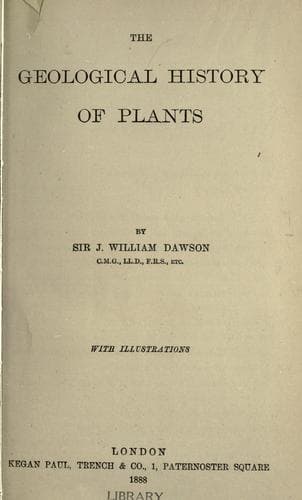
The Geological History of PlantsDawson, John William, Sir
Science
The Geological History of Plants
Dawson, John William, Sir
Paleobotany
5. When specific types disappear without any known successors, under
circumstances in which it seems unlikely that we should have failed to
discover their continuance, we may fairly assume that they have become
extinct, at least locally; and where the field of observation is very
extensive, as in the great coal-fields of Europe and America, we may
esteem such extinction as practically general, at least for the northern
hemisphere. When many specific types become extinct together, or in close
succession, we may suppose that such extinction resulted from physical
changes; but where single types disappear, under circumstances in which
others of similar habit continue, we may not unreasonably conjecture
that, as Pictet has argued in the case of animals, such types may have
been in their own nature limited in duration, and may have died out
without any external cause.
6. With regard to the _introduction_ of specific types we have not as
yet a sufficient amount of information. Even if we freely admit that
ordinary specific forms, as well as mere varieties, may result from
derivation, this by no means excludes the idea of primitive specific
types originating in some other way. Just as the chemist, after analysing
all compounds and ascertaining all allotropic forms, arrives at length at
certain elements not mutually transmutable or derivable, so the botanist
and zoölogist must expect sooner or later to arrive at elementary
specific types, which, if to be accounted for at all, must be explained
on some principle distinct from that of derivation. The position of
many modern biologists, in presence of this question, may be logically
the same with that of the ancient alchemists with reference to the
chemical elements, though the fallacy in the case of fossils may be of
more difficult detection. Our business at present, in the prosecution of
palæobotany, is to discover, if possible, what are elementary or original
types, and, having found these, to enquire as to the law of their
creation.
7. In prosecuting such questions geographical relations must be carefully
considered. When the floras of two successive periods have existed in
the same region, and under circumstances that render it probable that
plants have continued to grow on the same or adjoining areas throughout
these periods, the comparison becomes direct, and this is the case with
the Erian and Carboniferous floras in northeastern America. But, when
the areas of the two formations are widely separated in space as well
as in time, any resemblances of facies that we may observe may have no
connection whatever with an unbroken continuity of specific types.
Public-domain text, read in full here on John Shaqi.
Reviews
Reviews
No reviews yet
Be the first to share your thoughts on this work.
Elsewhere in the archive
Join the Discussion
Join the discussion
Sign in to leave a comment or review.
Sign InorCreate an account