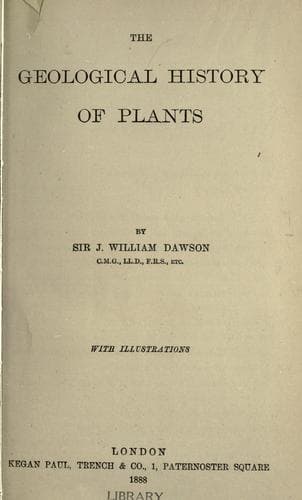
The Geological History of PlantsDawson, John William, Sir
Science
The Geological History of Plants
Dawson, John William, Sir
Paleobotany
In eastern Canada there is a very complete series of fossil plants,
extending from the Silurian to the Permian, and intermediate in its
species between the floras of interior America and of Europe. I may
use this succession, mainly worked out by myself,[FG] to summarise the
various Palæozoic floras and sub-floras, in order to give a condensed
view of this portion of the history of the vegetable kingdom, and to
direct attention to the important fact, too often overlooked, that there
is a definite succession of fossil plants as well as of animals, and
that this is important as a means of determining geological horizons.
A British list for comparison has been kindly prepared for me by Mr.
R. Kidston, F. Gr. S. For lists referring to the western and southern
portions of America, I may refer to the reports of Lesquereux and
Fontaine and White.[FH]
[FG] "Acadian Geology," "Reports on Fossil Plants of Canada," Geological
Survey of Canada.
[FH] "Geological Surveys of Pennsylvania, Ohio, and Illinois."
In this connection I am reminded, by an excellent little paper of M.
Zeiller,[FI] on Carboniferous plants from the region of the Zambesi,
in Africa, that the flora which in the Carboniferous period extended
over the temperate portions of the northern hemisphere and far into the
arctic, also passed across the equator and prevailed in the southern
hemisphere. Of eleven species brought from the Zambesi by M. Lapierre
and examined by M. Zeiller, all were identical with European species
of the upper coal-formation, and the same fact has been observed in the
coal flora of the Cape Colony.[FJ] These facts bear testimony to the
remarkable uniformity of climate and vegetation in the coal period, and
I perfectly agree with Zeiller that they show, when taken in connection
with other parallelisms in fossils, an actual contemporaneousness of the
coal flora over the whole world.
[FI] Paris, 1883.
[FJ] Grey, "Journal of the Geological Society," vol. xxvii.
1. Carboniferous Flora.
(1) _Permo-Carboniferous Sub-Flora_:
This occurs in the upper member of the Carboniferous system of Nova
Scotia and Prince Edward Island, originally named by the writer the
Newer Coal-formation, and more recently the Permo-Carboniferous, and
the upper beds of which may not improbably be contemporaneous with the
Lower Permian or Lower Dyas of Europe. In this formation there is a
predominance of red sandstones and shales, and it contains no productive
beds of coal. Its fossil plants are for the most part of species found
in the Middle or Productive Coal-formation, but are less numerous, and
there are a few new forms akin to those of the European Permian. The most
characteristic species of the upper portion of the formation, which has
the most decidedly Permian aspect, are the following:
Public-domain text, read in full here on John Shaqi.
Reviews
Reviews
No reviews yet
Be the first to share your thoughts on this work.
Elsewhere in the archive
Join the Discussion
Join the discussion
Sign in to leave a comment or review.
Sign InorCreate an account