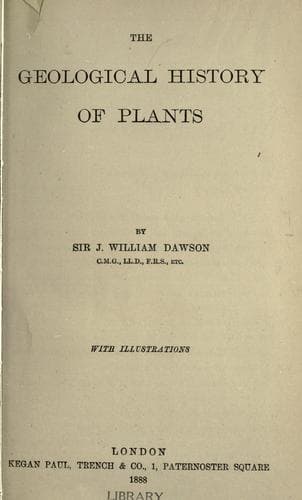
The Geological History of PlantsDawson, John William, Sir
Science
The Geological History of Plants
Dawson, John William, Sir
Paleobotany
In the upper beds of the Silurian, those of the Helderberg series, we
still find _Psilophyton_ and _Nematophyton_; but below these we know no
land-plants in Canada. In the United States, Lesquereux and Claypole have
described remains which may indicate the existence of lycopodiaceous and
annularian types as far back as the beginning of the Upper Silurian, or
even as low as the Hudson River group, and Hicks has found _Nematophyton_
and _Psilophyton_ in beds about as old in Wales, along with the uncertain
stems named _Berwynia_. In the Lower Silurian the _Protannularia_ of
the Skiddaw series in England may represent a land-plant, but this is
uncertain, and no similar species has been found in Canada.
The Cambrian rocks are so far barren of land-plants; the so-called
_Eophyton_ being evidently nothing but markings, probably produced by
crustaceans and other aquatic animals. In the still older Laurentian the
abundant beds of graphite probably indicate the existence of plants, but
whether aquatic or terrestrial it is impossible to decide at present.
It would thus appear that our certain knowledge of land-vegetation begins
with the Upper Silurian or the Silurio-Cambrian, and that its earliest
forms were Acrogens allied to Lycopods, and prototypal trees, forerunners
of the Acrogens or the gymnosperms. In the Lower Devonian little advance
is made. In the Middle Devonian this meagre flora had been replaced by
one rivalling that of the Carboniferous, and including pines, tree-ferns,
and arboreal forms of Lycopods and of equisetaceous plants, as well as
numerous herbaceous plants. At the close of the Erian the flora again
became meagre, and continued so in the Lower Carboniferous. It again
became rich and varied in the Middle Carboniferous, to decay in the
succeeding Permian.
II.--HEER'S LATEST RESULTS IN THE GREENLAND FLORA.
A very valuable report of Prof. Steenstrup, published in Copenhagen in
1883, the year in which Heer died, contains the results of his last
work on the Greenland plants, and is so important that a summary of its
contents will be interesting to all students of fossil botany or of the
vicissitudes of climate which the earth has undergone.[FQ]
[FQ] Meddelelser om Gronland, Hefte V., Copenhagen, 1883.
The plant-bearing beds of Greenland are as follows, in ascending order:
1. Cretaceous.
1. The _Komé_ series, of black shales resting on the Laurentian gneiss.
These beds are found at various other localities, but the name above
given is that by which they are generally known. Their flora is limited
to ferns, cycads, conifers, and a few endogens, with only _Populus
primæva_ to represent the dicotyledons. These beds are regarded as Lower
Cretaceous (Urgonian), but the animal fossils would seem to give them
a rather higher position. They may be regarded as equivalent to the
Kootanie and Queen Charlotte beds in Canada, and the Potomac series in
Virginia.
Public-domain text, read in full here on John Shaqi.
Reviews
Reviews
No reviews yet
Be the first to share your thoughts on this work.
Elsewhere in the archive
Join the Discussion
Join the discussion
Sign in to leave a comment or review.
Sign InorCreate an account