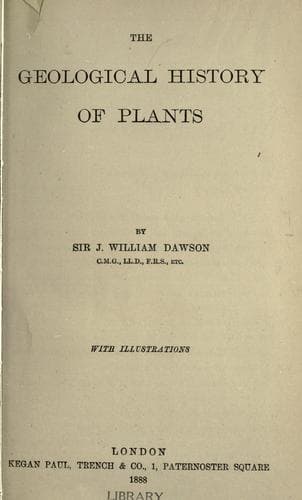
The Geological History of PlantsDawson, John William, Sir
Science
The Geological History of Plants
Dawson, John William, Sir
Paleobotany
The occurrence of this and other stems of tree-ferns in marine beds
has recently been illustrated by the observation of Prof. A. Agassiz
that considerable quantities of vegetable matter can be dredged from
great depths in the sea on the leeward side of the Caribbean Islands.
The occurrence of these trunks further connects itself with the great
abundance of large petioles (_Rhachiopteris_) in the same beds, while the
rarity of well-preserved fronds is explained by the coarseness of the
beds, and also by the probably long maceration of the plant-remains in
the sea-water.
In connection with this I may refer to the remarkable facts recently
stated by Williamson[BL] respecting the stems known as Heterangium and
_Lyginodendron_. It would seem that these, while having strong exogenous
peculiarities, are really stems of tree-ferns, thus placing this family
in the same position of advancement with the Lycopods and Equisetaceæ of
the Coal period.
[BL] "Proceedings of the Royal Society," January 6, 1887.
IV.--On Erian Trees of the Genus Dadoxylon, Unger. (_Araucarites_ of
Goeppert, _Araucarioxylon_ of Kraus.)
Large woody trunks, carbonised or silicified, and showing wood-cells with
hexagonal areoles having oval pores inscribed in them, occur abundantly
in some beds of the Middle Erian of America, and constitute the most
common kind of fossil wood all the way to the Trias. They have in the
older formations, generally, several rows of pores on each fibre, and
medullary rays composed of two or more series of cells, but become more
simple in these respects in the Permian and Triassic series. The names
_Araucarites_ and _Araucarioxylon_ are perhaps objectionable, inasmuch
as they suppose affinities to _Araucaria_ which may not exist. Unger's
name, which is non-committal, is therefore, I think, to be preferred. In
my "Acadian Geology," and in my "Report on the Geology of Prince Edward
Island," I have given reasons for believing that the foliage of some at
least of these trees was that known as _Walchia_, and that they may have
borne nutlets in the manner of Taxine trees (_Trigonocarpum_, &c). Grand
d'Eury has recently suggested that some of them may have belonged to
_Cordaites_, or to plants included in that somewhat varied and probably
artificial group.
Public-domain text, read in full here on John Shaqi.
Reviews
Reviews
No reviews yet
Be the first to share your thoughts on this work.
Elsewhere in the archive
Join the Discussion
Join the discussion
Sign in to leave a comment or review.
Sign InorCreate an account