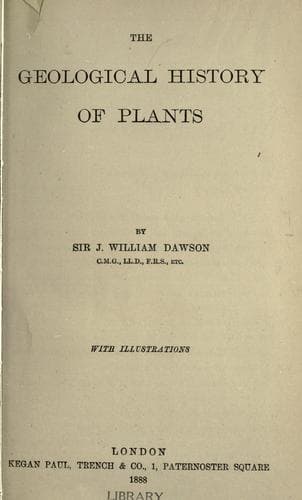
The Geological History of PlantsDawson, John William, Sir
Science
The Geological History of Plants
Dawson, John William, Sir
Paleobotany
It may be proper, before closing this note, to state the reasons which
have induced me to suggest in the following pages the use of the term
"Erian," as equivalent to "Devonian," for the great system of formations
intervening between the Upper Silurian and the Lower Carboniferous in
America. I have been induced to adopt this course by the following
considerations: 1. The great area of undisturbed and unaltered rocks
of this age, including a thickness in some places of eighteen thousand
feet, and extending from east to west through the Northern States of the
Union and western Canada for nearly seven hundred miles, while it spreads
from north to south from the northern part of Michigan far into the
Middle States, is undoubtedly the most important Devonian area now known
to geologists. 2. This area has been taken by all American geologists
as their typical Devonian region. It is rich in fossils, and these have
been thoroughly studied and admirably illustrated by the New York and
Canadian Surveys. 3. The rocks of this area surround the basin of Lake
Erie, and were named, in the original reports of the New York Survey,
the "_Erie Division_" 4. Great difficulties have been experienced in
the classification of the European Devonian, and the uncertainties thus
arising have tended to throw doubt on the results obtained in America in
circumstances in which such difficulties do not occur.
These reasons are, I think, sufficient to warrant me in holding the great
_Erie Division_ of the New York geologists as the typical representative
of the rocks deposited between the close of the Upper Silurian and the
beginning of the Carboniferous period, and to use the term Erian as the
designation of this great series of deposits as developed in America,
in so far at least as their flora is concerned. In doing so, I do not
wish to introduce a new name merely for the sake of novelty; but I hope
to keep before the minds of geologists the caution that they should
not measure the Erian formations of America, or the fossils which they
contain, by the comparatively depauperated representatives of this
portion of the geological scale in the Devonian of western Europe.
VII.--On the Relations of the so-called "Ursa Stage" of Bear Island with
the Palæozoic Flora of North America.
The following note is a verbatim copy of that published by me in
1873, and the accuracy of which has now been vindicated by the recent
observations of Nathorst:
Public-domain text, read in full here on John Shaqi.
Reviews
Reviews
No reviews yet
Be the first to share your thoughts on this work.
Elsewhere in the archive
Join the Discussion
Join the discussion
Sign in to leave a comment or review.
Sign InorCreate an account