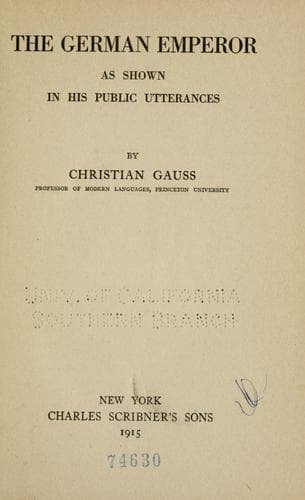
The German Emperor as Shown in His Public UtterancesWilliam II, German Emperor
History
The German Emperor as Shown in His Public Utterances
William II, German Emperor
Germany -- History -- William II, 1888-1918 -- Sources; Germany -- Politics And Government -- 1871-1918
The present speech and the one which follows it, to the working
men in Breslau, may conveniently be taken together, as they both
concern the Emperor's attitude toward the Socialists. Of all
his policies, his attempt to destroy this political party has
been least successful. It had increased from 763,000 in 1887 to
4,250,000 in 1912, when it numbered more than twice as many voters
as its nearest competitor, the Centre party, 1,996,000. The Emperor
had tried to introduce repeatedly subversion acts which would have
made for the persecution of this the largest political party in his
empire. When, on October 13, 1895, a manufacturer was murdered in
Mülhausen by a workman who had been repeatedly convicted of theft,
William II telegraphed to his widow: "Another sacrifice to the
revolutionary movement engendered by the Socialists." This hostile
attitude was unavailing and aroused the criticism of the greatest
German historian, Mommsen:
"It is unfortunately true that at the present time the Social
Democracy is the only great party which has any claim to political
respect. It is not necessary to refer to talent. Everybody in
Germany knows that with brains like those of Bebel it would be
possible to furnish forth a dozen noblemen from east of the Elbe in
a fashion that would make them shine among their peers.
"The devotion, the self-sacrificing spirit of the Social
Democratic masses, impresses even those who are far from sharing
their aims. Our Liberals might well take a lesson from the
discipline of the party." And again, only about a week after this
speech of the Emperor's Mommsen wrote:
"There must be an end of the superstition, as false as it is
perfidious, that the nation is divided into parties of law and
order on the one hand and a party of revolution on the other, and
that it is the prime political duty of citizens belonging to the
former category to shun the labor party as if it were in quarantine
for the plague and to combat it as the enemy of the state."
The Emperor has had many friends among the leaders in the
industrial world. Alfred Krupp had stood in close relation to his
sovereign and had been one of the founders and prime movers in
the German Navy League, which, more than anything else, had made
possible the realization of the imperial naval policy. The Emperor
is altogether mistaken in ascribing the stories circulated about
Krupp to the malignity of Social Democratic editors. Very ugly
rumors, whether true or false, had long before this time circulated
about this industrial leader; they could have been heard in other
countries of Europe, especially in Italy, and most particularly in
Tiberius's island of Capri, where he is said to have had a villa.
The address was delivered in the waiting-room of the station at
Essen on the day of Krupp's funeral.
Public-domain text, read in full here on John Shaqi.
Reviews
Reviews
No reviews yet
Be the first to share your thoughts on this work.
Elsewhere in the archive
Join the Discussion
Join the discussion
Sign in to leave a comment or review.
Sign InorCreate an account