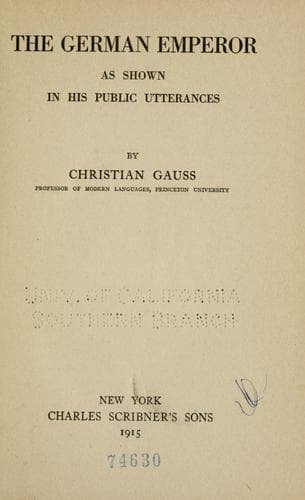
The German Emperor as Shown in His Public UtterancesWilliam II, German Emperor
History
The German Emperor as Shown in His Public Utterances
William II, German Emperor
Germany -- History -- William II, 1888-1918 -- Sources; Germany -- Politics And Government -- 1871-1918
It will have been noted that the Emperor usually addresses his
recruits in very simple language. On the occasion of administering
the oath to the naval recruits at Wilhelmshaven, he was concerned
about explaining to them the reasons for the Japanese victory, for
he had repeatedly told them that only a good Christian can be a
good soldier.
The speech was reported through a letter of one of the recruits.
The Emperor spoke, among other things, of the heroic deeds of the
Japanese and explained that they had sprung from the Japanese love
of country and children, which had begotten a splendid manliness in
the army and navy. He said that we must not conclude, however, from
the Japanese victories--the victories of a heathen over a Christian
people--that Buddha was superior to our Lord Christ. If Russia was
beaten, it was due for the most part, according to his opinion, to the
fact that Christianity in Russia was in a pretty bad way; and then,
too, there were many Christian virtues among the Japanese. A good
Christian is synonymous with a good soldier!
But Christianity is poorly off among the Germans also, and he--the
Emperor--doubted whether we Germans in case of a war would have any
special right to pray God for victory, to wrest it from Him in prayer
as Jacob did in his struggle with the angel. The Japanese were the
scourge of God just as once Attila and Napoleon were.
And so we must take care lest God should have to chastise us with such
a scourge, etc. The Emperor spoke very earnestly but very impressively
and simply, so that he could be understood by every one.
THE SALT OF THE EARTH
BREMEN, MARCH 22, 1905
The following address was delivered at the Rathaus in Bremen on the
occasion of the dedication of the monument to Emperor Frederick
III. The Emperor here presents his views on the mission of Germany
in much the same spirit in which it is expounded in a number of
his addresses of this time. He has become increasingly conscious
of her "manifest destiny" in the decade which had passed after the
celebrations of the twenty-fifth anniversary of the Franco-Prussian
War. Germany had entered upon a period of great prosperity and had
begun to possess the sense of latent power. The Emperor gives us
here the purely historical reasons which have led him to refrain
from pretensions to world-dominion. It is significant that his
next address will be delivered at Morocco. The question naturally
arises, what hopes or aspirations were in the minds of the audience
before whom the Emperor made this _gran rifiuto_. It was in a time
of insistent agitation by the Navy League and the Colonial party.
MY HONORED BURGOMASTER:
Public-domain text, read in full here on John Shaqi.
Reviews
Reviews
No reviews yet
Be the first to share your thoughts on this work.
Elsewhere in the archive
Join the Discussion
Join the discussion
Sign in to leave a comment or review.
Sign InorCreate an account