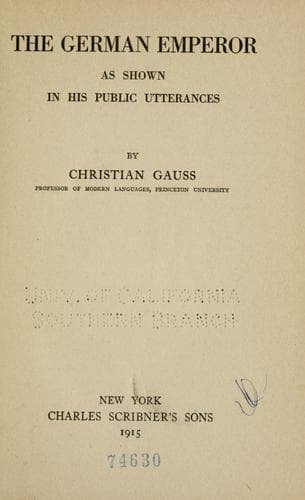
The German Emperor as Shown in His Public UtterancesWilliam II, German Emperor
History
The German Emperor as Shown in His Public Utterances
William II, German Emperor
Germany -- History -- William II, 1888-1918 -- Sources; Germany -- Politics And Government -- 1871-1918
On the 8th of April, 1904, an _entente_ which had settled all
outstanding questions between France and Great Britain and gave
to Great Britain a free hand in Egypt and to France a free hand
in Morocco was formally signed in London. The German Government
officially declared that the settlement between France and Great
Britain concerned only these two countries; but the Pan-German
Society, the Colonial Society, and the Navy League began so
insistent an agitation that the government changed its attitude
and the Emperor here declares in no uncertain terms that what
Germany undertakes in Morocco will be done exclusively with the
"_sovereign_ Sultan." Germany was evidently picking a quarrel with
France over Morocco, with or without warrant, as the case may
be, and was trying to ascertain, it is generally believed, the
closeness of the relationship between France and Great Britain.
The large commercial interests of which the Emperor speaks were
fairly negligible; though he doubtless had the right to protect it,
Germany's yearly trade there did not amount to as much as that of
an ordinary department store or of a fairly successful merchant.
For the previous eight years it averaged less than half a million
dollars annually. Her course here has usually been regarded as
unnecessarily belligerent.
True to his policy of personal diplomacy, the Emperor suddenly
appeared at Tangier and while there made his speech to the German
colony.
The whole question was taken up at the conference of Algeciras
in 1906. Although the policy of "the open door," which protected
Germany's commercial interests was guaranteed, the very general
storm of protest in Germany, especially on the part of the war
party and Navy League, showed that she had entered the contest with
more serious intentions. World policy by aggressive interference
had already been initiated when, in the Spanish-American War,
the German Admiral Diedrichs started to hamper the operations of
the American fleet at Manila. Morocco was looked upon by some,
Doctor Liman, for instance, as a second defeat. In the Algeciras
conference Italy sided with France and England. Italy had been
continuing as a member of the Triple Alliance partly through fear
that the French would annex Tripoli, which Italy desired. England
and France had now privately agreed to give Italy a free hand. She
sided with them and it was evident that her vital interests in the
Triple Alliance had been considerably lessened. As England and
Russia were also settling all their Eastern points of difference,
Germany began to be conscious of her isolation, which had been
largely a result of her attitude and unfortunate diplomacy.
I am pleased to make the acquaintance of the pioneers of Germany in
Morocco and to be able to tell them that they have done their duty.
Public-domain text, read in full here on John Shaqi.
Reviews
Reviews
No reviews yet
Be the first to share your thoughts on this work.
Elsewhere in the archive
Join the Discussion
Join the discussion
Sign in to leave a comment or review.
Sign InorCreate an account