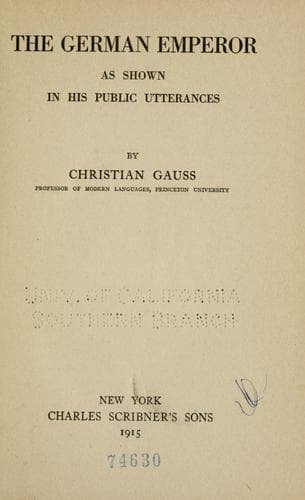
The German Emperor as Shown in His Public UtterancesWilliam II, German Emperor
History
The German Emperor as Shown in His Public Utterances
William II, German Emperor
Germany -- History -- William II, 1888-1918 -- Sources; Germany -- Politics And Government -- 1871-1918
What pleased him especially in the book was the optimistic tone which
pervaded it, the preaching which stimulated belief in life, and the
manner of accepting the misfortunes of existence, as well as the
trust in the future and trust in humanity. "This," said the Emperor,
"makes such an impression upon me because I am an optimist through and
through and will allow nothing to prevent me from remaining one to the
end of my days." He spoke of himself as a man full of his work and
one who believed in his tasks. He said further: "I will go forward.
I would greatly rejoice if men would understand me and would support
me in my desires." In this connection he spoke of the difficulty
every one encountered in his work on account of distrust. He again
recalled a passage from Ganghofer's "Schweigen im Walde" which had also
especially appealed to him because it had expressed his own point of
view concerning life. The passage runs: "He who distrusts, commits a
wrong against another and harms himself. It is our duty to believe that
every man is good so long as he does not give proof to the contrary."
"On this basis," said the Emperor, "I have always accepted every man
with whom I had anything to do. One may sometimes meet with unpleasant
experiences, but on that account he dare not give up. One must always
go on again with new trust in humanity and in life."
The Emperor then directed the conversation to a tablet which he had
had made and which contained, besides the above-mentioned quotation,
certain aphorisms of a like tenor from Ganghofer's novels.
These quotations appealed to him so strongly because they expressed
entirely his attitude toward life. With a good bit of optimism and a
bright and trustful outlook a man will go much further, not only in
his own personal life but in his vocation also, than he will if he
looks upon all things with a pessimistic eye; and even in politics
the case is the same. The German people certainly have a future, and
there is one word, "_Reichsverdrossenheit_" [sullenness toward imperial
destiny], which always offends him as often as he hears it. "What have
we to do with sullenness? Rather work and look forward. I work--yes,
not unwillingly--and I believe that I progress."
In connection with this word, the Emperor described the way in which
he worked every day and told how the difficulty of the many duties
and tasks which stormed in upon him often made him very weary. It
was at such times that the need overcame him to get out of harness
and see another part of the world, to become acquainted with other
men who stimulated him again. Thus, his journeys to the north always
invigorated him both mentally and physically.
Public-domain text, read in full here on John Shaqi.
Reviews
Reviews
No reviews yet
Be the first to share your thoughts on this work.
Elsewhere in the archive
Join the Discussion
Join the discussion
Sign in to leave a comment or review.
Sign InorCreate an account