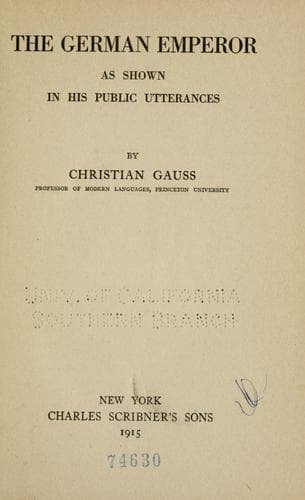
The German Emperor as Shown in His Public UtterancesWilliam II, German Emperor
History
The German Emperor as Shown in His Public Utterances
William II, German Emperor
Germany -- History -- William II, 1888-1918 -- Sources; Germany -- Politics And Government -- 1871-1918
A number of scandals in army and colonial administration had been
exposed in 1906. It will be remembered that for years back the
Emperor had been insisting on union between the various religious
creeds. This was perhaps due in part to a spirit of toleration,
but to a larger extent it was due to the fact that the Centre
party (Catholic) had for a number of years been in control. The
Reichstag of 1906 was dissolved, ostensibly over the government's
quarrel with the Centre party over the comparatively paltry sum of
$2,000,000 demanded for the Southwest African colony. In reality
the causes probably lay deeper. The late Reichstag had voted an
insufficient sum for the navy and was beginning to object to the
increasing taxes on the necessities of life. The Navy League was
demanding a doubling of the German fleet. The government seemed to
wish to undertake a more rapid policy of expansion. Mr. Barker
is authority for the statement that leaders of the imperialistic
agitation had gone so far as to recommend that if the Reichstag
did not vote the credits necessary for doubling the fleet, a _coup
d'état_ should be effected by the government and that it should
levy the taxes and govern in case of necessity against the will of
the Reichstag or without the Reichstag. The expansionist policy was
strongly advocated by the Colonial party and the Navy League and
was championed by the Chancellor. As the Social Democrats opposed
increases in taxation, they were likewise now specially under the
ban of official disapproval. There are usually about forty parties
in the Reichstag. The issue was, therefore, clearly drawn between
a policy of imperialism and a stronger insistence on world-policy,
on the one hand, and Social Democracy and the opposition on the
other. The Emperor and the Chancellor, particularly the latter,
threw themselves vigorously into the campaign, and in spite
of the support of the Centre party the Social Democrats lost
thirty-six representatives and their representation was reduced to
forty-three. Although the Social Democrats have to a certain point
supported the policy of commercial expansion, their defeat here may
be looked upon as the unconditioned triumph of imperialism.
On the night of February 5, when it was announced that the Social
Democrats had been defeated, a crowd gathered about the palace, and
when the Emperor returned at about midnight from the meeting of the
Electrical Society, where he had delivered an address, he stepped
out on his balcony and made the following speech to the crowd:
GENTLEMEN:
Public-domain text, read in full here on John Shaqi.
Reviews
Reviews
No reviews yet
Be the first to share your thoughts on this work.
Elsewhere in the archive
Join the Discussion
Join the discussion
Sign in to leave a comment or review.
Sign InorCreate an account