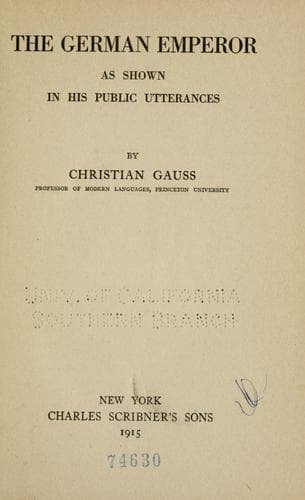
The German Emperor as Shown in His Public UtterancesWilliam II, German Emperor
History
The German Emperor as Shown in His Public Utterances
William II, German Emperor
Germany -- History -- William II, 1888-1918 -- Sources; Germany -- Politics And Government -- 1871-1918
Perhaps the most startling incident in the Emperor's reign and the
most extraordinary evidence of what may be called his "personal
diplomacy" policy was brought out by the publication of an
interview in the _Daily Telegraph_ of London. German sympathies
before and during the Boer War had been strongly pro-Boer. On the
third of January, 1896, the Emperor had telegraphed to President
Krüger: "I beg to express to you my sincere congratulations that,
without help from foreign powers, you have succeeded with your
own people and by your own strength in driving out the armed
bands which attempted to disturb the peace of your country and in
re-establishing order and in defending the independence of your
people from attacks from outside."
The German people had, therefore, assumed that the Emperor shared
their friendliness toward the Boers and that the government was
observing a policy of neutrality at least. When they learned
that his General Staff had been called upon, and that he had
prepared a plan of campaign against the Boers, a universal shout
of protest was raised. The publication of this interview, which
was designed to conciliate England, had a contrary effect upon
Holland, and the feeling that their ruler was held down by no
sense of responsibility was borne in forcibly upon the people.
The matter was made the subject of innumerable controversies,
debates in the Reichstag, and investigations. It was originally
announced that the interview had been given to an English diplomat
who had retired to private life. It was discovered that such was
not the case. It had been granted to an English journalist who
had written certain flattering articles about the Emperor. As for
the text, it was admitted that it was substantially authentic; it
had been shown to and had practically received the _visé_ of the
German Foreign Office. The Emperor's Chancellor, however, had not
seen the interview and under the storm of criticism offered his
resignation. This the Emperor did not accept, and the Chancellor
attempted to defend the Minister of Foreign Affairs. The Emperor
withdrew and for a time, like Achilles, pondered in his tent. Even
the Chancellor had to admit the Emperor's indiscretion and to
inform his sovereign that it would be impossible to carry out any
consistent foreign policy if the Emperor did not observe a proper
reserve in his public and private utterances.
Public-domain text, read in full here on John Shaqi.
Reviews
Reviews
No reviews yet
Be the first to share your thoughts on this work.
Elsewhere in the archive
Join the Discussion
Join the discussion
Sign in to leave a comment or review.
Sign InorCreate an account