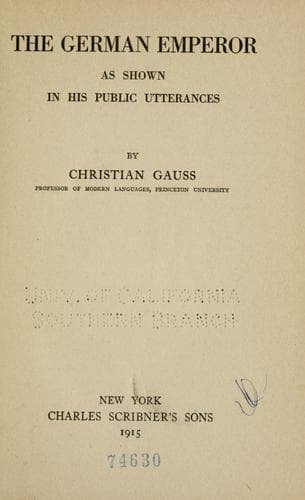
The German Emperor as Shown in His Public UtterancesWilliam II, German Emperor
History
The German Emperor as Shown in His Public Utterances
William II, German Emperor
Germany -- History -- William II, 1888-1918 -- Sources; Germany -- Politics And Government -- 1871-1918
to us by this noble figure whom the Fatherland and the citizens of
this city have so beautifully described on her simple monument as "the
good genius of the Prussian people." I cherish the hope that all of
the people of East Prussia who have gathered here will understand me
and that, as they return again to their work and their occupation,
they will think of these things. We must co-operate for the good of
the Fatherland, no matter who and where we are. And for me, too, the
conduct of this vanished Queen will be an example, as it was for
my grandfather. Looking upon myself as the instrument of the Lord,
without regard for daily opinions and intentions, I go my way, which is
devoted solely and alone to the welfare and peaceful development of the
Fatherland. But in this work I need the co-operation of every one in
the country and to this co-operation I would like to invite you also. I
empty my glass in the hope that this attitude may ever prevail in the
province of East Prussia and that it may lend me its assistance in my
labors. Long live the province of East Prussia!--Long may she prosper!
[44] In 1812 Prussia was ostensibly an ally of France. It was due to
General York, the commander of the Prussian Auxiliaries, rather
than to the Emperor's somewhat pusillanimous ancestor, King
Frederick William, that Prussia was liberated from the rule of
Napoleon. York commanded the Prussian troops who were to serve
as auxiliaries to Napoleon. On December 30, 1812, he, on his
own authority, concluded the convention of Tauroggen with the
Russians by which he broke with the French and declared his corps
neutral. The vacillating Prussian King, in spite of his country's
humiliation, was too solicitous about maintaining his throne to
dare venture upon any really decisive action. It was popular
pressure far more than the King's (or even the Queen's) initiative
which brought about the national uprising against foreign
domination.
THE HUNDREDTH ANNIVERSARY OF THE FOUNDING OF THE UNIVERSITY OF BERLIN
BERLIN, OCTOBER 11, 1910
The active interest which the Emperor has always taken in higher
education in Germany is evident in the following address. If he
has given it a powerful organization he has taken from it by
unconscious processes a large measure of its earlier freedom. The
professorial caste has always been highly influential. During the
Emperor's reign it has been pressed into his service. Its present
system of organization and its connection with the government
puts the Emperor, or at least the minister appointed by him,
in a position to distribute rewards. It is said that there are
practically no Social Democrats teaching in higher institutions of
learning.
In the early years of its foundation the university of Berlin
rendered immense services to the patriotic cause, especially
through the work of Fichte and Schleiermacher.
Public-domain text, read in full here on John Shaqi.
Reviews
Reviews
No reviews yet
Be the first to share your thoughts on this work.
Elsewhere in the archive
Join the Discussion
Join the discussion
Sign in to leave a comment or review.
Sign InorCreate an account