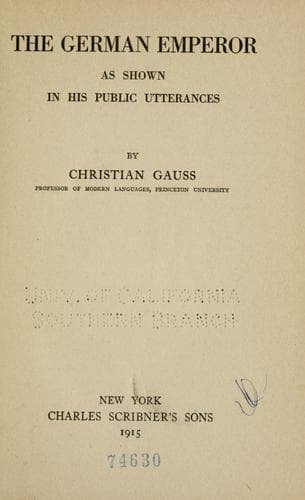
The German Emperor as Shown in His Public UtterancesWilliam II, German Emperor
History
The German Emperor as Shown in His Public Utterances
William II, German Emperor
Germany -- History -- William II, 1888-1918 -- Sources; Germany -- Politics And Government -- 1871-1918
I trust the healthy power of the German people, and, counting upon the
support of a gracious God, I look out hopefully over the struggles of
the day toward the future of the empire. Therefore, at the beginning of
a new legislative session, I offer you, Honored Sirs, my greeting in
the hope that your activities will be exerted for the benefit of the
people and the country.
BRANDENBURG ONCE AGAIN
MAY 30, 1912
The indications of particular good-will which the Emperor had
always exhibited for the Brandenburgers and the marks of special
favor which he had seemed to accord to them have occasionally
aroused a certain suspicion, not to say ill will, in the minds of
some of his South German subjects. In his hereditary provinces,
Brandenburg and Prussia, it will be noticed that the Emperor had
always expressed himself most freely with regard to his personal
pretensions that he ruled by divine right alone. The two speeches
which have been most criticised in this respect are the ones
delivered at Breslau (February 3, 1899) and Königsberg (August 25,
1910). They served, unfortunately, to accentuate the differences
which existed between the subjects in various parts of the empire
and to remind them that they had a Prussian Emperor. If certain
portions of his audiences here acquiesced in these pretensions of
their hereditary ruler and were somewhat proud of the particular
confidence he vouchsafed to them, critics, and even conservative
critics, referred to these ideas of "_Gottesgnadentum_,"
grace-of-Godism, with touches of what was at least irony. After
the unfortunate crisis following the _Daily Telegraph_ interview
Chancellor von Bülow had felt constrained to request the Emperor
"henceforward to observe, even in private interviews, that reserve
which is indispensable both to the interests of a consistent policy
and to the authority of the crown." As we have seen, in spite
of the Emperor's seeming acceptance of this necessity, it had
not modified to any particular extent the tenor of his speech at
Königsberg in 1910. It may be that by this time (1912) he had taken
the admonition to heart, for it will be noticed that, though we
have the customary reference to Frederick of Hohenzollern and the
glorification of his ancestors, and also the marks of special favor
and trust in the Brandenburgers, we miss any mention of the theory
of divine right.
Public-domain text, read in full here on John Shaqi.
Reviews
Reviews
No reviews yet
Be the first to share your thoughts on this work.
Elsewhere in the archive
Join the Discussion
Join the discussion
Sign in to leave a comment or review.
Sign InorCreate an account