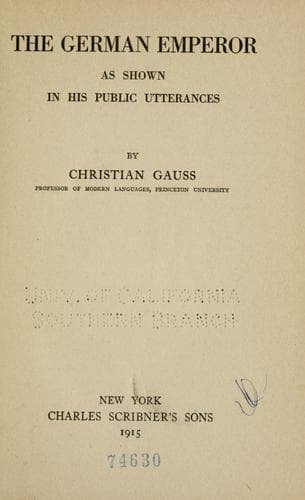
The German Emperor as Shown in His Public UtterancesWilliam II, German Emperor
History
The German Emperor as Shown in His Public Utterances
William II, German Emperor
Germany -- History -- William II, 1888-1918 -- Sources; Germany -- Politics And Government -- 1871-1918
The German Empire and the German crown rest upon a Brandenburg basis
and a Prussian foundation. On that account we wish on this day to
remember the people of the mark and of Brandenburg and not least the
Brandenburgers who in 1870 risked their lives and all that was near and
dear to them in order to win the imperial crown for the old master. As
long as a Hohenzollern lives and as long as there are Brandenburgers
both of them will remember Constantine Alvensleben, Vionville, and the
Third Corps.[48] This was the old Brandenburger loyalty which had been
preserved through all the centuries, and I hope that this loyalty may
be the possession of the coming generations of the city of Brandenburg.
And I drink this cup in the hope that this loyalty may never be
extinguished.
[48] Constantine Alvensleben, commander of the Third (Brandenburg) Army
Corps, played an important part in the battle of Vionville, on the
16th of August, 1870. He checked the French army operating from
Metz and held it until the arrival of reinforcements.
HAULING DOWN THE FLAG
HAMBURG, JUNE 18, 1912
As usual, the Emperor was present at the meeting of the North
German Regatta Association. Since 1897 he had been absent but
once. Certain references in his address here doubtless refer
back to the outcome of events at Agadir. It is difficult to tell
whether or not he is on the defensive. Whatever his qualities or
defects, it cannot properly be said that he has often or indeed
ever publicly weakened in a position which he had once taken. He
has, however, occasionally shifted his ground. Criticism, instead
of giving him pause, has usually had the effect of angering him
and of immediately drawing his fire upon his critics. So, in
regard to the criticism of his agrarian policy on the part of the
Prussian land-owning nobility, he replied that "opposition on the
part of the Prussian nobility is monstrous" [_ein Unding_]. As the
opposition had been directed solely against certain policies and
not against him personally, his statement implies that he expected
the Prussian nobility to support him in all of his positions. He
expected personal loyalty. As some of his opponents were members of
the Prussian Landtag, it is difficult to see what would become of
the idea of representative government in case the representatives
of the people waived their opinions and those of their constituents
in his favor. Some of the sharpest criticism which the Emperor
incurred was that which followed the incidents at Tangier in 1905
and at Agadir in 1911. In both cases what may be called the war
party showed great resentment, and certain of the criticisms made
by them seem to indicate that war, to them, was a consummation
devoutly to be wished, and the failure to make war at these
opportunities was looked upon as a defeat. The Emperor seems here
Public-domain text, read in full here on John Shaqi.
Reviews
Reviews
No reviews yet
Be the first to share your thoughts on this work.
Elsewhere in the archive
Join the Discussion
Join the discussion
Sign in to leave a comment or review.
Sign InorCreate an account