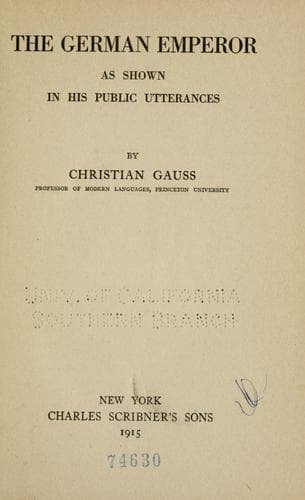
The German Emperor as Shown in His Public UtterancesWilliam II, German Emperor
History
The German Emperor as Shown in His Public Utterances
William II, German Emperor
Germany -- History -- William II, 1888-1918 -- Sources; Germany -- Politics And Government -- 1871-1918
Nineteen hundred and thirteen was a jubilee year in the history
both of Germany and in the Emperor's reign. In the first place,
it was the one-hundredth anniversary of the famous battle of the
nations at Leipzig, which marked the turning of the tide in the
fortunes of Napoleon. On innumerable occasions the Emperor, in
the speeches already printed, has referred to this crisis in
the affairs of Germany; he was, curiously enough, not to make
the address on this famous occasion, for the celebration was
to take place at Leipzig and the addresses were made by Doctor
Clemens and by the King of Saxony. The journals noted that during
the address of Doctor Clemens the Emperor, who was present,
showed no enthusiasm and looked bored. The joyous occasion had
been clouded by the unfortunate accident to the naval Zeppelin
L-2 on the previous day. As the Emperor had succeeded to the
throne on the fifteenth of June, 1888, the year marked also the
completion of twenty-five years of his reign, and the week of
June 15 had been one of continual celebration and many speeches.
He issued innumerable pardons and conferred many titles and
decorations, among them the title of general on his Chancellor,
Von Bethmann-Hollweg. His many speeches were, however, for the
most part, merely acceptances of congratulations and, aside from
the renewed expression of his hope to maintain peace, are not
particularly significant to the student. The sense of increased
tension is evident everywhere and seems to have reacted upon
him, as he does not express himself with his former enthusiasm.
He repeats his old themes, the necessity of disregarding party
divisions and in particular the need of holding fast to religious
ideals and of moral regeneration.
On the seventeenth of October, 1913, on the eve of the great
national celebration, the naval Zeppelin L-2, shortly after
starting on a flight from Johannisthal to Hamburg, met with a
most distressing accident. An explosion occurred, the balloon
caught fire and burst, and the gondola fell with its crew. The
twenty-seven officers and men were killed. From Bonn the Emperor
issued the following statement. The text, as well as that of the
speech of June 23, 1914, is taken from the _Berliner Tageblatt_.
Again fate has laid a heavy hand upon my navy. The dirigible L-2 was
destroyed by an explosion, and nearly thirty brave men, among them many
of the ablest in developing this new species of warcraft, lost their
lives. Their death in the service of the Fatherland will be honorably
remembered by me and the entire German people. Our very deepest
sympathy goes out to their relatives. But grief over what has happened
will only spur us on to renewed efforts to develop this so important
aerial weapon into a reliable engine of war.
WILLIAM, I. R.
Public-domain text, read in full here on John Shaqi.
Reviews
Reviews
No reviews yet
Be the first to share your thoughts on this work.
Elsewhere in the archive
Join the Discussion
Join the discussion
Sign in to leave a comment or review.
Sign InorCreate an account