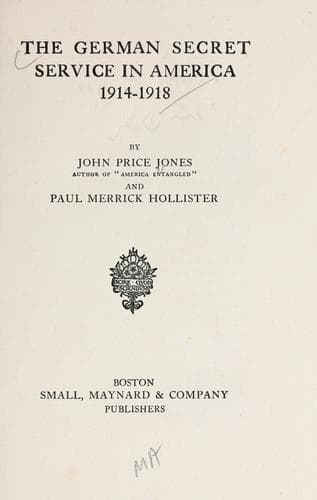
The German Secret Service in America 1914-1918Jones, John Price
History
The German Secret Service in America 1914-1918
Jones, John Price
World War, 1914-1918 -- Secret service -- Germany
A German editor in the United States had the effrontery to announce
that American ships would be sunk as readily as the _Lusitania_.
Secretary Bryan, of the Department of State, at that time a confirmed
pacifist, resigned his post on June 8, thus drawing the sting of a
second and sharper protest which went forward to Germany the next
day. To this the Foreign Office replied on July 8 that American
ships would be safe in the submarine zone under certain conditions,
and the President on July 21 rejected this diplomatic sop as "very
unsatisfactory." Count von Bernstorff finally announced, on September
1, that German submarines would sink no more liners without warning,
and his government ratified his promise a fortnight later. The
promise was at best a quibble, and it in no way restricted undersea
depredations upon commerce and human life. After the _Lusitania_
affair followed the _Leelanaw_, the _Arabic_, and the _Hesperian_
and on February 16, 1916, Germany acknowledged her liability for the
_Lusitania's_ destruction--the day after Secretary Lansing declared the
right of commercial vessels to arm themselves in self-defense, and five
days before the Crown Prince began the ten-months' battle of Verdun.
The published correspondence of the State Department gives in detail
the negotiations regarding maritime relations, a record of Imperial
hypocrisy which indicates clearly the desire and intention of the
Germans to retain their submarine warfare at any cost. There is not
space here to brief the papers, nor any great need, for it was the
_Lusitania_ which dictated the tone and outcome of the correspondence,
and which brought the United States rudely face to face with the cruel
facts of war.
In spite of these facts, Germany employed her agents in desperate,
devious and futile attempts to gloss over the crime. Relatives of those
who had drowned were persuaded by agents (one of them was "a lawyer
named Fowler, now under Federal indictment on another count") to sue
the Cunard Line for damages for having mounted guns on the liner,
thus making her liable to attack. Paul Koenig paid a German, Gustave
Stahl, of Hoboken, to swear to an affidavit that he had seen guns on
the ship; this affidavit was forwarded by Captain Boy-Ed on June 1, to
Washington, and had a wide temporary effect upon public sentiment until
Stahl was convicted of perjury and sentenced to 18 months in Atlanta.
It was Koenig who hid Stahl where neither the police nor the press
could find him after he made his statement, and it was Koenig who, at
the command of the Federal authorities, produced him. It was Rintelen
who dined on the night of the tragedy at the home of one of the
victims; it was Rintelen who received the news with a mild expression
of regret because "he had two good men aboard."
Public-domain text, read in full here on John Shaqi.
Reviews
Reviews
No reviews yet
Be the first to share your thoughts on this work.
Elsewhere in the archive
Join the Discussion
Join the discussion
Sign in to leave a comment or review.
Sign InorCreate an account