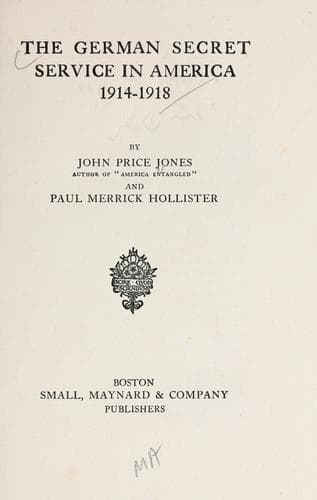
The German Secret Service in America 1914-1918Jones, John Price
History
The German Secret Service in America 1914-1918
Jones, John Price
World War, 1914-1918 -- Secret service -- Germany
She wasted no time in injecting her verbal propagandists into the
struggle on the American front. On August 20, 1914, Dr. Karl Oskar
Bertling, assistant director of the Amerika Institut in Berlin,
landed in New York, and went at once to report to von Bernstorff. The
Amerika Institut had of recent years made considerable progress in
familiarizing Germany with American affairs; its chief director, Dr.
Walther Drechsler, had been master of German in Middlesex, a prominent
boys' school in Massachusetts; he returned to Berlin in 1913 and was
attached, upon the outbreak of war, to the press office. All who were
associated with it knew something of America. It is characteristic of
the convertibility of German institutions to war that another executive
of this organization, employed in peace times to cement the friendship
between the two nations, should be sent on the day war was declared to
America to establish a German press bureau.
Dr. Bertling went about delivering pro-German speeches, and prepared
articles for the press on international questions. These he submitted
to Bernstorff himself for approval--one such story was to be published
in a Sunday magazine supplement to a long "string" of American
newspapers. Although every editor was on the lookout for any "war
stuff" which was written with any apparent background of European
politics, he found small market for his wares among the New York
newspapers, and some of his speaking dates were cancelled. He proposed
to publish, with one of his stories, a set of German military maps of
Belgium, but to this von Papen wrote him on November 21: "I entirely
agree with you in your opinion in regard to the maps--it is a two-edged
sword," and he added: "One observes how very ill-informed the average
American is." Bertling's lack of accomplishment drew censure, however,
from several sources: the head of the German-American Chamber of
Commerce in Berlin chided him for not having carried out his "special
mission to supply a cable service to South America and China," and the
late Professor Hugo Muensterberg of Harvard waxed righteously indignant
over the fact that Bertling opened and read a letter entrusted by the
psychologist to him for safe delivery to Dr. Dernburg. Bertling applied
to the Embassy for special employment, and on March 19, 1915, the
ambassador's private secretary wrote him:
"His Excellency is entirely agreeable to giving you the desired
employment, but he considers the present conditions too uncertain, as
his departure for Germany in the near future is not impossible."
Excellent testimony to the subtle iniquity of his task lies in
the names of the men whose pro-Ally utterances he was striving to
counteract. In a letter written December 20, 1914, to Bertling by C. W.
Ernst, a Bostonian of German birth and American naturalization, appears
this passage:
Public-domain text, read in full here on John Shaqi.
Reviews
Reviews
No reviews yet
Be the first to share your thoughts on this work.
Elsewhere in the archive
Join the Discussion
Join the discussion
Sign in to leave a comment or review.
Sign InorCreate an account