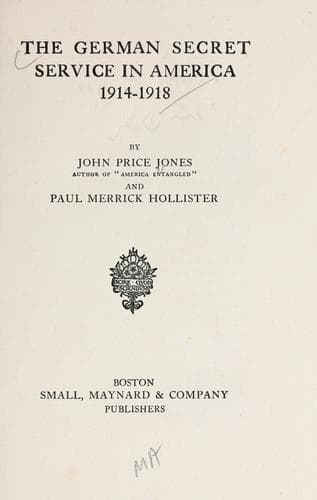
The German Secret Service in America 1914-1918Jones, John Price
History
The German Secret Service in America 1914-1918
Jones, John Price
World War, 1914-1918 -- Secret service -- Germany
"5. Finally it is of the utmost importance that the authorities as well
as the German people cease continually to discuss publicly the delivery
of American arms and ammunition, as well as to let every American feel
their displeasure about it."
The Foreign Office never saw fit to act upon the investigator's
proposals, for less than a month after he had written his report, it
appeared, verbatim, in the columns of a New York newspaper. Axiom: The
most effective means of fighting enemy propaganda is by propaganda for
which the enemy unwittingly supplies the material.
[Illustration: Copy of a check from Count von Bernstorff to the Fair
Play Printing and Publishing Company]
Motion pictures appealed to the Germans as a practical and graphic
means of spreading through America visual proof of their kindness
to prisoners, their prodigious success with new engines of war, and
their brutal reception at the hands of the nations they were forced
in self-defence to invade. So Dr. Albert financed the American
Correspondent Film Company, two of whose stockholders were Claussen
and Dr. Karl A. Fuehr, a translator in Viereck's office. As late as
August, 1916, Karl Wunnenberg and Albert A. Sander, of the "Central
Powers Film Company," which was also subsidized to circulate
German-made moving pictures, engaged George Vaux Bacon, a free-lance
theatrical press agent, to go to England at a salary of $100 a week,
obtain valuable information, and transmit it in writing in invisible
ink to Holland, where it would be forwarded to Germany. The two
principals were later indicted on a charge of having set afoot a
military enterprise against Great Britain, and were sentenced to two
years in prison; Bacon, the cat's-paw, received a year's sentence.
(Sander, a German, had been involved in secret-agent work on a previous
occasion when he assaulted Richard Stegler for not disavowing an
affidavit explaining his acquisition of a false passport.) The secret
ink they gave Bacon was invisible under all conditions unless a certain
chemical preparation, which could be compounded only with distilled
water, was applied to it.
At the start of the war there began in Congress a vehement debate
over the question of imposing a legislative embargo on the shipment
of arms and ammunition to the Allies. In these debates participated
men who undoubtedly were sincere in the convictions they expressed.
Nevertheless, in the late winter and early spring of 1915, a hireling
of the Germans began to seek secret conferences with congressmen in a
Washington hotel and to outline to them plans for compelling an embargo
on munitions. His activities bring us to the affairs of the National
German-American Alliance, Germany's most powerful and least tangible
factor of general propaganda in the United States.
Public-domain text, read in full here on John Shaqi.
Reviews
Reviews
No reviews yet
Be the first to share your thoughts on this work.
Elsewhere in the archive
Join the Discussion
Join the discussion
Sign in to leave a comment or review.
Sign InorCreate an account