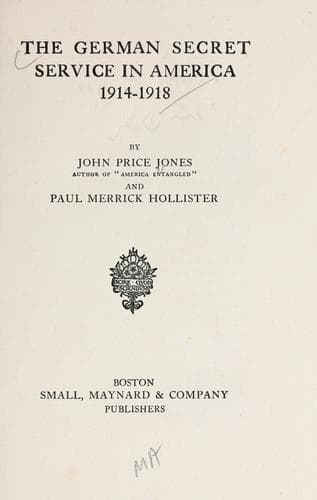
The German Secret Service in America 1914-1918Jones, John Price
History
The German Secret Service in America 1914-1918
Jones, John Price
World War, 1914-1918 -- Secret service -- Germany
Whether or not General Huerta was to "return to Mexico some day"
depended upon the temper of the United States. He knew that when he
authorized the statement. He did not know--or else he was incredibly
bold--that the Government was in possession of the whole story, and
that orders had been issued from the highest source in the country
not to let him return. One day in the late summer he slipped away,
ostensibly to visit the San Francisco Exposition. Government agents
shadowed him and let him make his own pace. He took the southern route,
and traveled so quietly that his flight was not publicly marked until
he had passed through Kansas City. As he approached the border he
became as eager as a boy at the prospect of his 'return from Elba';
then, as he was almost in sight of the soil from which he had been
exiled, he was arrested on a technical charge and jailed.
In August Rintelen fled the country. The _Providence Journal_ had just
published an irritating charge that Boy-Ed was carrying on negotiations
with Mexico; the German Embassy denied the charge, although Boy-Ed
with his knowledge of Mexico had assisted ably in the plot; and the
excitement of official interest in Huerta's recent connections made von
Rintelen nervous. When he was captured at Falmouth by the British, his
man-Friday, Andrew V. Meloy, confessed that he had inadvertently tipped
over the plot when he had innocently telephoned a Carranzista to find
out, for safety sake, whether the Carranza party suspected Huerta. It
was this Carranzista who made a few inquiries of his own, and succeeded
in planting the spy in the Holland House meeting.
The aged general, although he was transferred to a more comfortable
prison, took his confinement bitterly. His dream had been bright
indeed, and it had been bluntly interrupted. As the autumn came on his
health showed signs of failing, and his career of dissipation began
to total the final reckoning. The illness became grave, and after
two surgical attempts to save his life, he died in January, 1916,
heartbroken.
Von Eckhart, the minister to Mexico City, was to Mexico what
Bernstorff was to the United States and he employed faithfully the
familiar tactics of his superior: revolution, editorial propaganda,
filibustering and double dealing. In the fall of 1916 the fine German
hand could be seen prompting a note sent by Mexico to the United
States urging an embargo on the shipment on munitions and foodstuffs
to the warring nations (Mexico had neither foodstuffs nor munitions to
supply). And in December, 1916, Eckhart was robbed of the achievement
of a conspiracy of fantastic proportions.
Public-domain text, read in full here on John Shaqi.
Reviews
Reviews
No reviews yet
Be the first to share your thoughts on this work.
Elsewhere in the archive
Join the Discussion
Join the discussion
Sign in to leave a comment or review.
Sign InorCreate an account