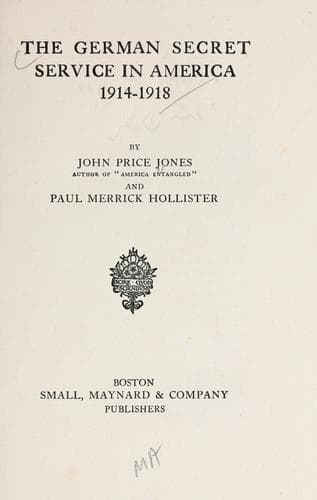
The German Secret Service in America 1914-1918Jones, John Price
History
The German Secret Service in America 1914-1918
Jones, John Price
World War, 1914-1918 -- Secret service -- Germany
This charge was denied at once from Washington. The specific "violation
of international law and of American law" to which Devoy referred was
generally supposed to be the seizure of the von Igel papers, for the
accusation is the same as that which von Igel made when his office was
raided. How Devoy knew that the von Igel papers contained information
of the proposed expedition from Kiel to Ireland is a question which
Devoy has no doubt had to answer to the Government of the United States
since then. He and O'Leary, with Dennis Spellisy, who had collected
large sums of money for the Sinn Fein cause, were loud in their
protests against the execution of the ringleaders of the revolt on May
3rd, which put a sharp end to the endeavors of the revolutionists. That
O'Leary was known to the German system of secret agents in America
needs no further substantiation. To credit him with generalship,
however, would be doing him too great honor and the Irish-American
population injustice; O'Leary was bitterly pro-German, but so were
hundreds of more prominent and influential Irish-Americans: one could
find the names of several New York Justices upon the roster of the
Friends of Peace. Sir Roger Casement petitioned for a Philadelphia
lawyer at his trial for treason, and Sir Roger's sister attempted
unsuccessfully to reach President Wilson, through his secretary, Joseph
P. Tumulty, in an effort to bring about intercession in the doomed
knight's favor. (Mr. Tumulty was approached more than once by persons
whom he had reason to suspect of alloyed motives who desired to "set
forth a case to the President.") The link between the old country and
the new is close, the future of Ireland is one of more than usual
interest and concern to the United States, and the fact that the great
majority of Irish-Americans have subordinated their insular convictions
to the greater conviction of loyalty to their adopted land is at once a
fine augury of ultimate solution of the Irish question, and a dignified
rebuke to the efforts which Germany has made through America to exploit
Ireland.
On Washington's Birthday, 1916, there came to New York one who posed
as a French publisher and publicist. He brought excellent letters of
recommendation, and was well supplied with money. He was personable,
and well sponsored, and he was correspondingly well received. Within
a month he left the United States for France, with appropriate
expressions of his appreciation of American hospitality.
In April, 1918, that same man faced a French firing squad, guilty of
having attempted to betray his country, and of having traded with the
enemy.
Public-domain text, read in full here on John Shaqi.
Reviews
Reviews
No reviews yet
Be the first to share your thoughts on this work.
Elsewhere in the archive
Join the Discussion
Join the discussion
Sign in to leave a comment or review.
Sign InorCreate an account