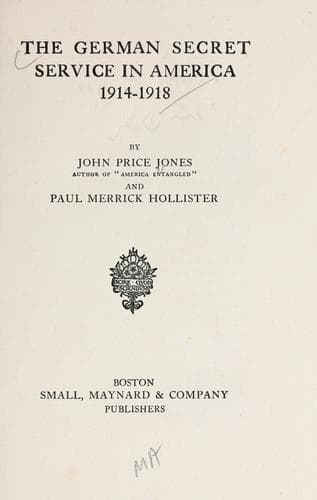
The German Secret Service in America 1914-1918Jones, John Price
History
The German Secret Service in America 1914-1918
Jones, John Price
World War, 1914-1918 -- Secret service -- Germany
When the German fleet put into neutral American ports of refuge in
1914 the personnel of its ships totalled 476 officers and 4,980 men.
When the ships were seized in 1917, there were 368 officers and 826
men aboard. Of those who had been discharged or allowed indefinite
shore leave a considerable number were active German agents, by far
the great majority were German citizens, and the United States was
on the horns of a dilemma: either each of the sailors ashore must be
watched on suspicion, or else each was free to go about the country as
he pleased. Thus more than 4,000 potential secret agents from an active
auxiliary arm of the German navy were dumped on the hospitality which
our neutrality entailed. When war was declared those men came within
the troublesome problem of the status of the enemy alien.
What was an enemy alien? The United States, on April 6, declared war
against Germany. "Meanwhile," reads the report of the Attorney-General
for 1917, "prior to the passage of the joint resolution of Congress
of April 6, 1917, elaborate preparation was made for the arrest of
upward of 63 alien enemies whom past investigation had shown to
constitute a danger to the peace and safety of the United States if
allowed to remain at large." These "alien enemies" were male Germans.
Not Austrians, for the United States did not go to war with Austria
until December 7. Not Bulgars, nor Turks, for the United States has not
declared war upon Bulgaria or Turkey. Not female Germans, in the face
of the full knowledge of the predilections of Bernstorff, Boy-Ed, and
von Papen for employing women in espionage. Of the thousands of Germans
in the United States whose sympathies were presently to be demonstrated
in numerous ways against the successful prosecution of America's war,
sixty-three had been deemed worthy of arrest. By June 30 this number
had risen to 295, and by October 30 to 895. "Some of those, interned,"
continues the report, "have been paroled with the necessary bonds and
restrictions." Although the United States went to war on April 6, Karl
Heynen, who managed the Bridgeport Projectile Company for Bernstorff
and Albert, and who had previously earned the good will of the United
States by gun-running in Mexico, was not arrested until July 6, in his
offices in the Hamburg-American Line at 45 Broadway. At the same time
F. A. Borgemeister, former adviser to Dr. Albert, and latterly Heynen's
lieutenant, was arrested. Both were interned at Fort Oglethorpe and
during December, Borgemeister was allowed three weeks' liberty on
parole. Rudolph Hecht, confidant of Dr. Albert, who had sold German
war loan bonds for the Kaiser, and who had also been interned, was
released for a like period of liberty in December. G. B. Kulenkampf,
who had secured false manifest papers for the supply-ship _Berwind_ in
August, 1914, was arrested on May 28, 1918, more than one year after
America had entered the war; on the same day Robert J. Oberfohren, a
Public-domain text, read in full here on John Shaqi.
Reviews
Reviews
No reviews yet
Be the first to share your thoughts on this work.
Elsewhere in the archive
Join the Discussion
Join the discussion
Sign in to leave a comment or review.
Sign InorCreate an account