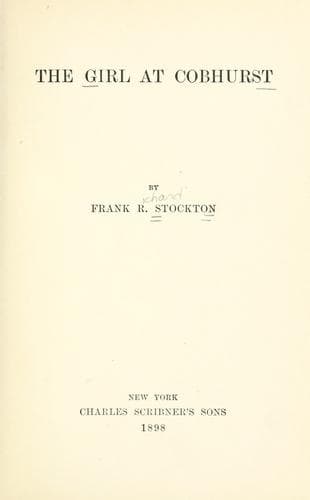
Humorous stories; Love stories; Villages -- Fiction
The tarts, indeed, were wonderful things to look at, resembling, as
Miriam had said, a plateful of little chimneys, with a sort of swallow's
nest of jam at the top, but Ralph did not laugh at them.
"Wait until their turn comes," said Ralph, "and I will give my opinion
about them."
When he had finished the substantial part of the meal, he drew the plate
of tarts toward him.
"I will show you how to eat the Cobhurst tart. You cut it down from top
to bottom: then you lay the two sections on their rounded sides: then you
get a lot more of jam, which I see you have on the side table, and you
spread the cut surfaces with it: then you put it together as it was
before, and slice it along its shorter diameter. Good?" said he; "they
are delicious."
Miriam took a piece. "It is good enough," she said, "but it is not a
tart. If Dora Bannister had made them, they would have been real tarts."
"It is very well I said nothing about the dog," thought Ralph; and then
he said aloud, "It is not Dora Bannister that we have to consider; it is
Molly Tooney. She is to save you from the tears and perplexities of flour
and yeast, and to make you the happy little lady of the house that you
were before the wicked Phoebe went away. But one thing I insist upon: I
want the rest of those tarts for my breakfast."
Miriam looked at her brother with a smile that showed her storm was over.
"You are eating those things, dear Ralph," she said, "because I made
them, and that is the only good thing about them."
CHAPTER XXI
THE DRANES AND THEIR QUARTERS
In a small room at the back of Dr. Tolbridge's house there sat a young
woman by the window, writing. This was Cicely Drane; and although it was
not yet ten days since Miss Panney broached her plan of the employment of
Miss Drane as the doctor's secretary, or rather copyist, here she was,
hard at work, and she had been for two days.
The window opened upon the garden, and in the beds were a great many
bright and interesting flowers, but paying no heed to these, Cicely gave
her whole attention to her task, which, indeed, was not an easy one. With
knitted brows she bent over the manuscript of the "Diagnosis of
Sympathy," and having deciphered a line or two, she wrote the words in a
fair hand on a broad sheet before her. Then she returned to the study of
the doctor's caligraphy, and copied a little more of it, but the
proportion of the time she gave to the deciphering of the original
manuscript to that occupied in writing the words in her own hand was
about as ten is to one. An hour had elapsed since she had begun to write
on the page, which she had not yet filled.
Public-domain text, read in full here on John Shaqi.
Reviews
Reviews
No reviews yet
Be the first to share your thoughts on this work.
Elsewhere in the archive
Join the Discussion
Join the discussion
Sign in to leave a comment or review.
Sign InorCreate an account