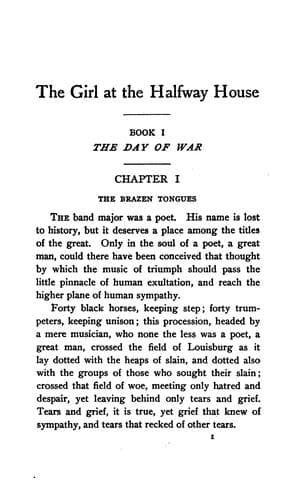
The Girl at the Halfway House: A Story of the PlainsHough, Emerson
General
The Girl at the Halfway House: A Story of the Plains
Hough, Emerson
Great Plains -- Fiction; Historical fiction, American
Sam, the owner of the livery barn, had one table in the corner, where
he invariably sat. His mode of entering the dining-room varied not
with the passing of the years. Appearing at the door, he cast a
frightened look at the occupants who had preceded him, and in whose
faces he could imagine nothing but critical censure of his own person.
Becoming aware of his hat, he made a dive and hung it up. Then he trod
timidly through the door, with a certain side-draught in his step, yet
withal an acceleration of speed which presently brought him almost at a
run to his corner of refuge, where he dropped, red and with a gulp.
Often he mopped his brow with the unwonted napkin, but discovery in
this act by the stern eye of Nora, the head waitress, caused him much
agony and a sudden search for a handkerchief. When Nora stood at his
chair, and repeated to him frostily the menu of the day, all the world
went round to Sam, and he gained no idea of what was offered him. With
much effort at nonchalance, he would again wipe his face, take up his
fork for twiddling, and say always the same thing.
"Oh, I ain't very hungry; jes' bring me a little pie an' beef an'
coffee." And Nora, scornfully ignoring all this, then departed and
brought him many things, setting them in array about his plate, and
enabling him to eat as really he wished. Whether Sam knew that Nora
would do this is a question which must remain unanswered, but it is
certain that he never changed the form of his own "order."
Sam was a citizen. He had grown up with the town. He was, so to
speak, one of the charter members of Ellisville, and thereby entitled
to consideration. Moreover, his business was one of the most lucrative
in the community, and he was beyond the clutching shallows and upon the
easy flood of prosperity. No man could say that Sam owed him a dollar,
nor could any man charge against him any act of perfidy, except such as
might now and then be connected with the letting of a "right gentle"
horse. There was no reason why Sam might not look any man in the face,
or any woman. But this latter Sam had never done. His admiration for
Nora bade fair to remain a secret known of all but the one most
interested. Daily Sam sat at the table and listened to Nora's icy
tones. He caught his breath if the glitter of her glasses faced him,
and went in a fever as he saw her sail across the floor. Daily he
arose with the stern resolve that before the sun had set he would have
told this woman of that which so oppressed him; yet each day, after he
had dined, he stole furtively away to the hat rack and slouched across
the street to his barn, gazing down at his feet with abasement on his
soul. "I ain't afeard o' any hoss that ever stood up," said he to
himself, "but I can't say a word to that Nory girl, no matter how I
try!"
Public-domain text, read in full here on John Shaqi.
Reviews
Reviews
No reviews yet
Be the first to share your thoughts on this work.
Elsewhere in the archive
Join the Discussion
Join the discussion
Sign in to leave a comment or review.
Sign InorCreate an account