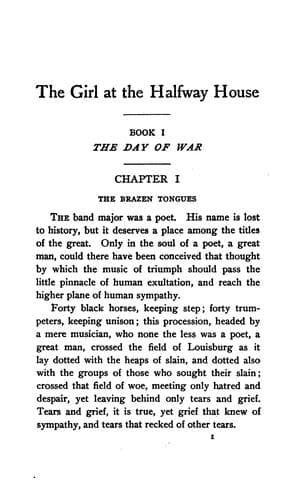
The Girl at the Halfway House: A Story of the PlainsHough, Emerson
General
The Girl at the Halfway House: A Story of the Plains
Hough, Emerson
Great Plains -- Fiction; Historical fiction, American
"I should say not!" said Sam, with the only lie he ever told, and one
most admirable. "I should say not!" he repeated with emphasis, and in
tones which carried conviction even to himself.
"You'd better not!" said Nora. "I wouldn't of had you if they had!"
Sam started. "What's that, Nory?" he said. "Say that ag'in! Did you
say you wouldn't of _had_ me--you wouldn't _of_?" His hand found hers
again.
"Yes," faltered Nora, seeing herself entrapped by her own speech.
"Then, Nory," said Sam firmly, casting a big arm about her waist, "if
you wouldn't _of_ had me then, I reckon now you _do_." And neither
from this subtlety nor from the sturdy arm did Nora seek evasion,
though she tugged faintly at the fingers which held fast her waist.
"I don't care," she murmured vaguely. "There ain't no coward would of
done it!" Whereat Sam, seeing himself a hero, wisely accepted fate and
ceased to argue. The big arm tightened manfully, and into his blue
eyes came the look of triumph.
"Nory," whispered he loyally, "I'll never work my airs ag'in for any
woman in the world but you!"
CHAPTER XXXV
THE HILL OF DREAMS
Franklin found himself swept along with a tide of affairs other than of
his own choosing. His grasp on the possibilities of the earliest days
of this new civilization had been so full and shrewd that he needed now
but to let others build the house whose foundation he had laid. This
in effect has been the history of most men who have become wealthy, the
sum of one man's efforts being in no great disparity actually superior
to those of his fellow-man.
Yet Franklin cared little for mere riches, his ambition ceasing at that
point where he might have independence, where he might be himself, and
where he might work out unfettered the problems of his own
individuality. Pursued by a prosperity which would not be denied, his
properties growing up about him, his lands trebling in value within a
year and his town property rising steadily in value, he sometimes
smiled in very grimness as he thought of what this had once and so
recently been, and how far beyond his own care the progress of his
fortunes had run. At times he reflected upon this almost with regret,
realizing strongly the temptation to plunge irrevocably into the battle
of material things. This, he knew, meant a loosing, a letting go, a
surrender of his inner and honourable dreams, an evasion of that
beckoning hand and a forgetting of that summoning voice which bade him
to labour agonizingly yet awhile toward other aims. The inner man,
still exigent, now exhorted, now demanded, and always rebelled.
Franklin's face grew older. Not all who looked upon him understood,
for to be _hors concours_ is to be accursed.
Public-domain text, read in full here on John Shaqi.
Reviews
Reviews
No reviews yet
Be the first to share your thoughts on this work.
Elsewhere in the archive
Join the Discussion
Join the discussion
Sign in to leave a comment or review.
Sign InorCreate an account