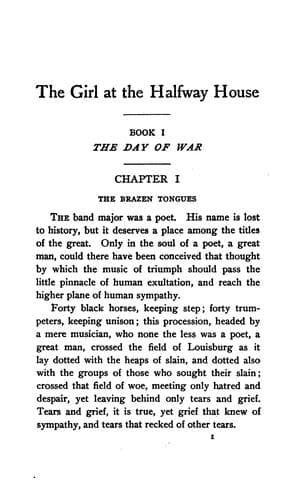
The Girl at the Halfway House: A Story of the PlainsHough, Emerson
General
The Girl at the Halfway House: A Story of the Plains
Hough, Emerson
Great Plains -- Fiction; Historical fiction, American
Franklin really lost a part of what the speaker was saying. He was
gazing at this form half hidden in the shadows, a figure with hands
drooping, with face upturned, and just caught barely by one vagrant ray
of light which left the massed shades piled strongly about the heavy
hair. There came upon him at that moment, as with a flood-tide of
memory, all the vague longing, the restlessness, the incertitude of
life which had harried him before he had come to this far land, whose
swift activity had helped him to forget. Yet even here he had been
unsettled, unhappy. He had missed, he had lacked--he knew not what.
Sometimes there had come vague dreams, recurrent, often of one figure,
which he could not hold in his consciousness long enough to trace to
any definite experience or association--a lady of dreams, against whom
he strove and whom he sought to banish. Whom he had banished! Whom he
had forgotten! Whom he had never known! Who had ever been in his life
a vague, delicious mystery!
The young woman rose, and stood out a pace or two from the shadows.
Her hand rested upon the arm of the elder lady. She turned her face
toward Franklin. He felt her gaze take in the uniform of blue, felt
the stroke of mental dislike for the uniform--a dislike which he knew
existed, but which he could not fathom. He saw the girl turn more
fully toward him, saw upon her face a querying wonder, like that which
he had known in his own dreams! With a strange, half-shivering gesture
the girl advanced half a step and laid her head almost upon the
shoulder of the elder woman, standing thus for one moment, the arms of
the two unconsciously entwined, as is sometimes the way with women.
Franklin approached rudeness as he looked at this attitude of the two,
still puzzling, still seeking to solve this troubling problem of the
past.
There came a shift in the music. The air swept from the merry tune
into the minor from which the negro is never musically free. Then in a
flash Franklin saw it all. He saw the picture. His heart stopped!
This music, it was the wail of trumpets! These steps, ordered,
measured, were those of marching men. These sounds, high, commingling,
they were the voices of a day gone swiftly by. These two, this
one--this picture--it was not here, but upon the field of wheat and
flowers that he saw it now again--that picture of grief so infinitely
sad.
Franklin saw, and as he gazed, eager, half advancing, indecision and
irresolution dropped from him forever. Resolved from out the shadows,
wherein it had never in his most intimate self-searching taken any
actual form, he saw the image of that unformulated dream which had
haunted his sub-consciousness so long, and which was now to haunt him
openly and forever.
CHAPTER XV
ANOTHER DAY
The morning after the first official ball in Ellisville dawned upon
another world.
Public-domain text, read in full here on John Shaqi.
Reviews
Reviews
No reviews yet
Be the first to share your thoughts on this work.
Elsewhere in the archive
Join the Discussion
Join the discussion
Sign in to leave a comment or review.
Sign InorCreate an account