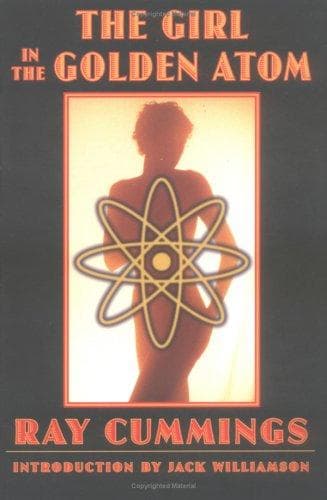
Atoms -- Fiction; Chemists -- Fiction; Love stories; Science fiction
Lylda's father greeted them gravely, with a dignity, and yet obvious
cordiality that was quite in accord with his appearance. He was a man
over sixty. His still luxuriant white hair fell to his shoulders. His
face was hairless, for in this land all men's faces were as devoid of
hair as those of the women. He was dressed in a long, flowing robe
similar to those his visitors were wearing.
"Because--you come--I am glad," he said with a smile, as he shook hands
in their own manner. He spoke slowly, with frequent pauses, as though
carefully picking his words. "But--an old man--I know not the language
of you."
He led them into a room that evidently was his study, for in it they saw
many strange instruments, and on a table a number of loosely bound
sheets of parchment that were his books. They took the seats he offered
and looked around them curiously.
"There is the clock we spoke of," said the Chemist, indicating one of
the larger instruments that stood on a pedestal in a corner of the room.
"Reoh will explain it to you."
Their host addressed the Chemist. "From Oteo I hear--the news to-day is
bad?" he asked with evident concern.
"I am afraid it is," the Chemist answered seriously.
"And Lylda?"
The Chemist recounted briefly the events of the day. "We can only wait
until Lylda returns," he finished. "To-morrow we will talk with the
king."
"Bad it is," said the old man slowly; "very bad. But--we shall see----"
The Very Young Man had risen to his feet and was standing beside the
clock.
"How does it work?" he asked. "What time is it now?"
Reoh appealed to his son-in-law. "To tell of it--the words I know not."
The Chemist smiled. "You are too modest, my father. But I will help you
out, if you insist." He turned to the others, who were gathered around
him, looking at the clock.
"Our measurement of our time here," he began, "like yours, is based
on----"
"Excuse me," interrupted the Very Young Man. "I just want to know first
what time it is now?"
"It is in the fourth eclipse," said the Chemist with a twinkle.
The Very Young Man was too surprised by this unexpected answer to
question further, and the Chemist went on.
"We measure time by the astronomical movements, just as you do in your
world. One of the larger stars has a satellite which revolves around it
with extreme rapidity. Here at Arite, this satellite passes nearly
always directly behind its controlling star. In other words, it is
eclipsed. Ten of these eclipses measure the passage of our day. We rise
generally at the first eclipse or about that time. It is now the fourth
eclipse; you would call it late afternoon. Do you see?"
"How is the time gauged here?" asked the Big Business Man, indicating
the clock.
Public-domain text, read in full here on John Shaqi.
Reviews
Reviews
No reviews yet
Be the first to share your thoughts on this work.
Elsewhere in the archive
Join the Discussion
Join the discussion
Sign in to leave a comment or review.
Sign InorCreate an account