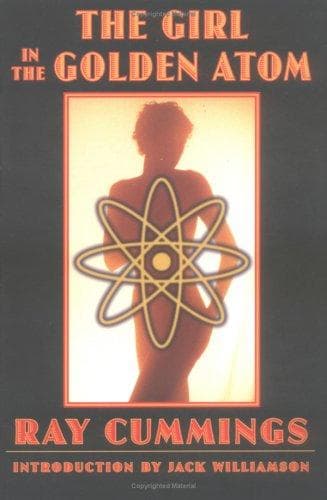
Atoms -- Fiction; Chemists -- Fiction; Love stories; Science fiction
"Nature seems to have taken care of that," the Chemist answered, "and as
a matter of fact quite the reverse is true. Women mature in life at an
age you would call about sixteen. But early marriages are not the rule;
seldom is a woman married before she is twenty--frequently she is much
older. Her period of child-bearing, too, is comparatively
short--frequently less than ten years. The result is few children, whose
rate of mortality is exceedingly slow."
"How about the marriages?" the Very Young Man suggested. "You were going
to tell us."
"Marriages are by mutual consent," answered the Chemist, "solemnized by
a simple, social ceremony. They are for a stated period of time, and are
renewed later if both parties desire. When a marriage is dissolved
children are cared for by the mother generally, and her maintenance if
necessary is provided for by the government. The state becomes the
guardian also of all illegitimate children and children of unknown
parentage. But of both these latter classes there are very few. They
work for the government, as do many other people, until they are of age,
when they become free to act as they please."
"You spoke about women being different than we knew them; how are they
different?" the Very Young Man asked. "If they're all like Lylda I think
they're great," he added enthusiastically, flushing a little at his own
temerity.
The Chemist smiled his acknowledgment of the compliment. "The status of
women--and their character--is I think one of the most remarkable things
about this race. You will remember, when I returned from here the first
time, that I was much impressed by the kindliness of these people.
Because of their history and their government they seem to have become
imbued with the milk of human kindness to a degree approaching the
Utopian.
"Crime here is practically non-existent; there is nothing over which
contention can arise. What crimes are committed are punished with a
severity seemingly out of all proportion to what you would call justice.
A persistent offender even of fairly trivial wrongdoing is put to death
without compunction. There is no imprisonment, except for those awaiting
trial. Punishment is a reprimand with the threat of death if the offense
is committed again, or death itself immediately. Probably this very
severity and the swiftness with which punishment is meted out, to a
large extent discourages wrongdoing. But, fundamentally, the capacity
for doing wrong is lacking in these people.
"I have said practically nothing exists over which contention can arise.
That is not strictly true. No race of people can develop without some
individual contention over the possession of their women. The passions
of love, hate and jealousy, centering around sex and its problems, are
as necessarily present in human beings as life itself.
Public-domain text, read in full here on John Shaqi.
Reviews
Reviews
No reviews yet
Be the first to share your thoughts on this work.
Elsewhere in the archive
Join the Discussion
Join the discussion
Sign in to leave a comment or review.
Sign InorCreate an account