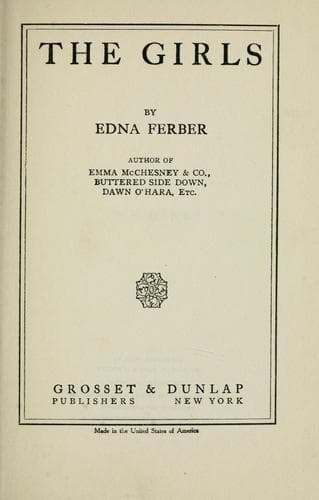
Chicago (Ill.) -- Fiction; Families -- Fiction; Women -- Fiction; World War, 1914-1918 -- Fiction
"A cigarette boy, eh? Well, let me tell you something, youngster. A
hundred of those'll do you more harm than a barrel of these. Yessir!
You take a fella smokes a mild cigar after his meal, why, when he's
through with that cigar he's through--for awhile, anyway. He don't
light another right away. But start to smoke a cigarette and first
thing you know where's the package!"
Jesse appeared to consider this gravely. Ben Gartz leaned back
supported by one hand, palm down, on the ground. His left was hooked in
the arm-hole of his vest. One leg was extended stiffly in front of him,
the other drawn up. He puffed at his cigar.
Lottie rose abruptly. "I'll clear these things away." She smiled at
Jesse and Charley. "You two children go for a walk. I know you're dying
to. I'll have everything slicked up in a jiffy."
"Oh, I think not," the two answered. They knew what was sporting and
rigidly followed certain forms of conduct. Having eaten, they expected
to pay. They scraped, cleared, folded, packed with the deftness of
practiced picnickers. Jesse Dick's eye was caught by the name on the
cover of a discarded pasteboard box.
"Oh, say! You got this stuff at father's."
"Yes; we stopped on the way----"
The boy tapped the cover of the box and grinned. "Best delicatessen
in Chicago, Illinois, ladies and gents, if I say it as shouldn't.
Dad certainly pickles a mean herring." His face sobered. "He's an
artist in his line--father. Did you ever see one of his Saturday night
windows? He'll have a great rugged mountain of Swiss cheese in the
background, with foothills of Roquefort and Edam. Then there'll be a
plateau of brown crackly roasted turkeys and chickens, and below this,
like flowers in the valley, all the pimento and mayonnaise things, the
salads, and lettuces and deviled eggs and stuffed tomatoes." (His poem
"Delicatessen Window" is now included in the volume called "Roughneck.")
"I understand you're a poet," Ben Gartz remarked, quizzically. For him
there was humour in the very word.
"Yes."
"Now that's funny, ain't it--with your father in the delicatessen
business and all?"
Again Jesse Dick seemed to ponder seriously. "Maybe it is. But I know
of quite a good poet who was apprenticed to a butcher."
"Butcher! No!" Ben roared genially. "What poet was that?"
Jesse Dick glanced at Charley then. He looked a little shame-faced; and
yet, having begun, he went through with it. "Shakespeare, his name was.
Will Shakespeare."
"Oh, say, what's this you're giving me!" But the faces of the three
were serious. "Say, is that right?" He appealed to Lottie.
"It's supposed to be true," she said, gently, "though it has been
doubted." Lottie had brought along the olive-drab knitting in a little
flowered cretonne bag. She sat on the ground now, in the sunlight, her
back against a tree, knitting.
Public-domain text, read in full here on John Shaqi.
Reviews
Reviews
No reviews yet
Be the first to share your thoughts on this work.
Elsewhere in the archive
Join the Discussion
Join the discussion
Sign in to leave a comment or review.
Sign InorCreate an account