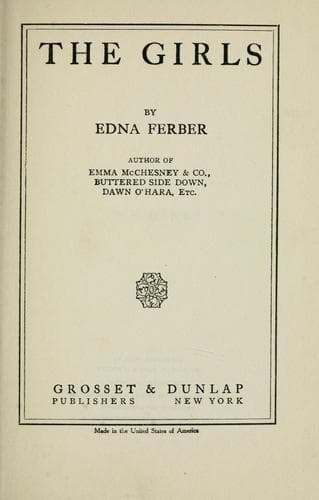
Chicago (Ill.) -- Fiction; Families -- Fiction; Women -- Fiction; World War, 1914-1918 -- Fiction
And Ben Gartz thrived. If anyone had ever doubted Ben Gartz's business
foresight that person was forever silenced now. On every martial male
left arm--rookie or general, gob or admiral--reposed a wrist watch.
And now when Ben Gartz offered Henry a plump brown cylinder with the
customary "Have a cigar!" Henry took it reluctantly, if reverently,
eyed its scarlet and gold belly-band with appreciation, and knew better
than to proffer one of his own inferior brand in return. "I'll smoke
it after dinner," he would say, and tuck it away in his vest pocket.
Henry Kemp had aged in the last year. His business was keeping its head
barely above water with the makeshift of American manufactured products.
It had been during the winter before the war--February, 1917--that
Charley Kemp had announced one evening to her father and mother that
she intended to marry Jesse Dick when she was twenty. That would be in
June. He had got a job as feature writer with the Chicago News Bureau
and he was acting as motion picture critic for one of the afternoon
papers. His comment was caustic but highly readable. His writing in
this new field was characterised by the same crude force that made his
poetry a living thing.
"Well, was I right or wasn't I?" demanded Mrs. Payson of her daughter
Belle. "Talking about her five children like a--like a hussy!"
"Hussies don't have five children," Belle retorted, meaninglessly.
Mrs. Payson endeavoured to arouse her daughter to the necessity for
immediate action against this proposed madness of Charley's. "You've
got to stop it, that's all."
"Stop it how?"
"How! By forbidding it, that's how."
Belle could even smile at that. "Oh, mother, aren't you quaint!
Nowadays parents don't forbid girls marrying this man or that,
any more than they lock them up in a high tower like the princess
What's-her-name in the fairy tale."
"You let me talk to her," said Mrs. Carrie Payson. "I'll do a little
plain speaking."
Her plain speaking consisted in calling Jesse Dick a butcher's boy and
a good-for-nothing scribbler who couldn't earn a living. Charley heard
her out, a steely light in her eyes.
She spoke quietly and with deadly effect. "You're my grandmother, but
that doesn't entitle you to talk to me with the disrespect you've just
shown."
"Disrespect! To you! Well, upon my word!"
"Yes, I know it strikes you as extraordinary. If it had been written
'Honor thy sons and thy daughters' along with 'Honor Thy Father and
Thy Mother' there'd have been a lot less trouble in the world. You
never did respect your own people--your own family. You've never shown
respect to Lottie or to mother, or to father or to Aunt Charlotte, for
that matter. So why should I expect you to respect me. I'm marrying
Jesse Dick because he's the man I want to marry. I may be making a
mistake but if I am I'm willing to pay for it. At least I'll have only
myself to reproach."
"You children to-day think you know everything, but you don't. You
wait. You'll see. I know."
Public-domain text, read in full here on John Shaqi.
Reviews
Reviews
No reviews yet
Be the first to share your thoughts on this work.
Elsewhere in the archive
Join the Discussion
Join the discussion
Sign in to leave a comment or review.
Sign InorCreate an account