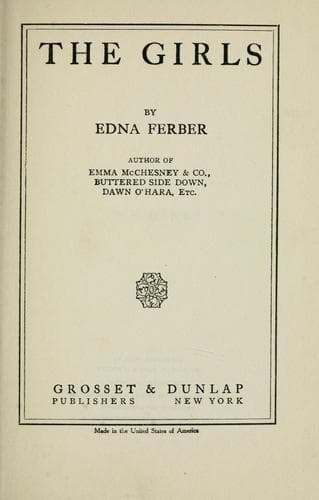
Chicago (Ill.) -- Fiction; Families -- Fiction; Women -- Fiction; World War, 1914-1918 -- Fiction
They drove to the Marigold Gardens on the North Side. Jesse had not
sold his little flivver. The place was a fairyland of lights, music,
flower-banked terraces. Hundreds were dining outdoors under the
moonlight, the women in pale-coloured organdies and chiffons, the men
in Palm Beach suits or in uniforms. No where else in America could one
find just this sort of thing--nor, for that matter, in Europe even in
the days before the war. In a city constantly referred to as crude,
commercial, and unlovely there flourished two garden spots unique,
exquisite and unproclaimed.
Jesse ordered a dinner that brought a look of wonder to the face of the
waiter (Swiss, of course) who had gauged his prospective order after
one glance at the ill-fitting issue uniform.
"Dance?" said Jesse.
"Yes." They danced, wordlessly. They danced before and after the hors
d'œuvres, the fowl, the salad, the dessert, the coffee. They talked
little. The boy glanced about with cold wise young eyes. "God!"
"Yes, I know," Charley said, as if in answer to a long speech, "but
after all what good would it do if they all stayed home! They're
probably all doing their share. They hate it as much as you do. Moping
won't help."
"Dance?"
"Yes."
They rose and wound their way among the little green tables to the
dancing platform. Charley raised her eyes to his as they danced. "Will
you marry me to-morrow, Jesse? Before you go?"
"No."
"Why not?"
"That's all right for truck drivers and for sloppy emotionalists. But
it's a poor plan. You're only suggesting it because of the music and
my nearness and the fact that I'm leaving day after to-morrow. I'm no
different than I was three months ago. I hate war as much as I ever
did. If you think three months of camp training----"
"Will you marry me to-morrow, Jesse?"
"No."
"I'm afraid, Jesse."
"So am I. But not as scared as that." His cheek rested against hers.
Her fingers clutched tight a fold of the bunchy cloth of his rough
uniform. She could not bring herself to name the fear she felt. All the
way home she pressed close to the rough sleeve--the good tangible rough
cloth of the sleeve--and the muscle-hard arm within it.
Public-domain text, read in full here on John Shaqi.
Reviews
Reviews
No reviews yet
Be the first to share your thoughts on this work.
Elsewhere in the archive
Join the Discussion
Join the discussion
Sign in to leave a comment or review.
Sign InorCreate an account