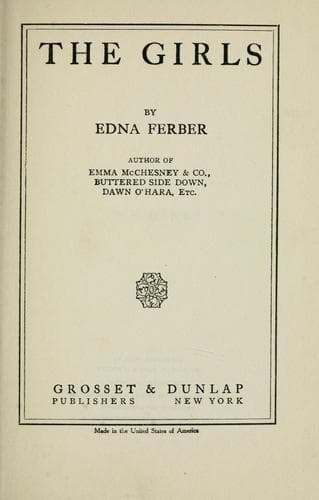
Chicago (Ill.) -- Fiction; Families -- Fiction; Women -- Fiction; World War, 1914-1918 -- Fiction
Mrs. Payson knew what was going on. She knew the price of coal, and the
whereabouts of the Cingalese troops, and the closing Steel quotations,
and whether duvetyne was going to be good this winter, and how much the
Claflin estate amounted to, and why the DeWitts dropped their divorce
proceedings. More than this, she read aloud extracts from these items
and commented thereon. She was the kind of woman who rarely breakfasts
in a kimono. When she did it was so restrained and somber in cut and
colour that the Nipponese would have failed to recognise its origin.
Her white hair was primly dressed. Through spectacles worn at a rakish
angle and set rather low down on her nose she surveyed the antics of
the world and pronounced upon them as a judge upon a day's grist of
cases. To one who preferred to get the first-page news first-hand it
was a maddening practice.
"I see they predict a coal famine. I don't know what we'll do in this
house. If I didn't know I'd practically have to give it away I'd
sell and move into a flat out south.... They're going to wear those
capes again next winter. I should think they'd freeze in 'em. Though
I remember we used to wear them altogether--dolmans, we called them.
I see your friend Winnie Steppler has gone to France for her paper.
Woman of her age! I should think she'd stay home.... H'm! Ben Gartz
is captain of the Manufacturing Jewelers' Liberty Loan committee....
What time did you come in last night, Lottie? I didn't hear you." Aunt
Charlotte, breakfasting across the table, looked up.
Lottie poured herself another cup of coffee. She was drinking a
great deal of coffee lately; using it frankly as a stimulant. "About
midnight."
"Did you have a nice time?"
"Interesting," Lottie said, gravely. She sensed that her mother was
listening intently behind the newspaper. "Did you mean what you just
said about wanting to sell the house and moving into a flat out south?"
Mrs. Payson's spectacles showed, half-moons, above the paper's horizon.
"I might. Hulda's going to marry that man. He doesn't want to go to
war. They say you can't get a girl now for less than fifteen dollars a
week. Fifteen! Well! I see myself! And now this coal shortage--and a
four-story house. Still, we'd need a pretty big apartment."
Lottie made her tone casual. "You ought to marry off Jeannette--and me."
She knew that Ben Gartz leaped from a position of doubt to one of hope
in her mother's mind. She knew, too, that her mother could no more
force herself to speak of this hope than she could wear a pink silk and
lace negligee. She would have considered both, somehow, indecent. She
turned a page of the paper, elaborately careless. "I'd move out of this
barn fast enough if there was only Charlotte and me to keep it up for."
Lottie laughed a little. "You'd have to have a special room for Ole
Bull, and your walnut bed and the hall hatrack. No modern flat----"
Public-domain text, read in full here on John Shaqi.
Reviews
Reviews
No reviews yet
Be the first to share your thoughts on this work.
Elsewhere in the archive
Join the Discussion
Join the discussion
Sign in to leave a comment or review.
Sign InorCreate an account