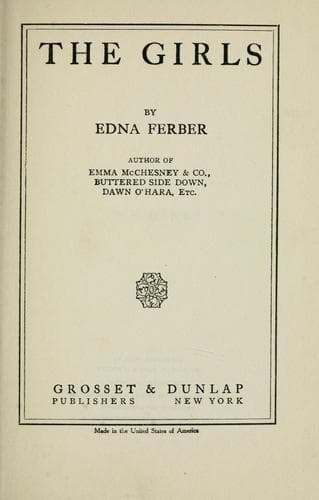
Chicago (Ill.) -- Fiction; Families -- Fiction; Women -- Fiction; World War, 1914-1918 -- Fiction
Then for three weeks the household went about its business. Lottie
sewed at the Red Cross shop; Aunt Charlotte knitted; Mrs. Payson talked
Liberty Bonds, managed her household, protested at the increased cost
of living, berated Belle for what she termed her extravagance, quizzed
Henry about his business at the Friday night family dinner. At the end
of the month Hulda left to marry her unmartial Oscar. Though she and
Mrs. Payson had carried on guerilla warfare for years, Hulda, packing
her trunk, wept into the crochet-edged trousseau and declared that Mrs.
Payson had been, of all mistresses, the kindest. Mrs. Payson, on her
part, facing the prospect of breaking in a pert new incompetent at a
weekly wage far beyond that of the departing and highly capable Hulda,
forgave her everything, including her weakness for coffee. She even
plied her with a farewell cup of that black brew as Hulda, dressed for
departure, sat waiting red-eyed in the kitchen for the drayman.
With the advent of a new maid Jeannette began to take her meals with
the family. Somehow the kitchen was no longer the place for Jeannette.
She had acquired a pretty manner, along with a certain comeliness of
feature and figure. It had been a sudden blossoming. Hers were the
bright-eyed assurance, the little upward quirk at the corners of the
mouth, the preenings and flutterings of the duckling who is transformed
miraculously into a swan. Jeannette had a "boy friend." Jeannette had
invitations for every night in the week (censored by Mrs. Payson).
Jeannette went to the War Camp Community dances on Saturday nights at
the Soldiers' and Sailors' Club and was magically transformed from
a wall-flower into a rose. Jeannette, the erstwhile plain, bloomed
into beauty--the beauty that comes of being told one is beautiful and
desirable. She danced expertly and gracefully (private sessions with
Charley had accomplished this) and she had endless patience with the
wistful lads from the near-by naval training station and camps who
swarmed into the city on leave, seeking diversion where they could find
it. At these carefully supervised Community affairs Jeannette danced
with boys from Texas and boys from Massachusetts; boys from Arizona and
Kansas and Ohio and Washington. But though she danced with them all
with indefatigable patience and good-humour it was Nebraska's step that
perfectly matched her own after the first few weeks and it was Nebraska
who took her home at a gallop in order not to overstay his shore leave.
Nebraska was an embryo ensign. He talked of the sea as only a boy can
who has known but the waves of the wheat rippling before the wind
across miles of inland prairie. When Lottie suggested that Jeannette
invite Nebraska to dinner on Sunday Mrs. Payson, surprisingly enough,
agreed. They made conversation.
"And where is your home?"
"I'm from Nebraska, ma'am."
"Oh, Nebraska!"
"Yes, ma'am."
"How do you like Chicago?"
Public-domain text, read in full here on John Shaqi.
Reviews
Reviews
No reviews yet
Be the first to share your thoughts on this work.
Elsewhere in the archive
Join the Discussion
Join the discussion
Sign in to leave a comment or review.
Sign InorCreate an account