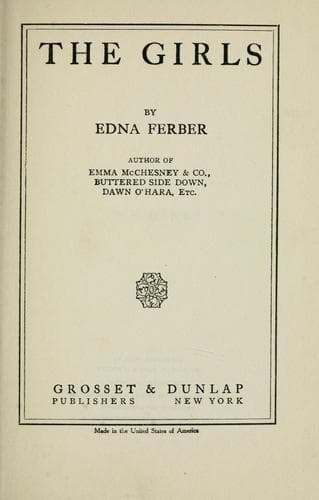
Chicago (Ill.) -- Fiction; Families -- Fiction; Women -- Fiction; World War, 1914-1918 -- Fiction
His day stretched, empty, before him, but he made himself busy. Each
morning he rose at the hour to which his business had accustomed him
for years. He bathed and shaved and dressed carefully, as usual. He
breakfasted and glanced at the paper, doing both with the little air of
hurry that had meant the car waiting outside, or the 8:45 I. C. train
to catch. For twenty-five years he had gone downtown daily at a certain
time, his face alight with the eager alert expression which meant the
anticipation of a heavy mail and a day crowded with orders. He still
followed out this programme. But the eager look was absent. His springy
step was suddenly heavy, lagging. Belle sometimes wondered where he
went--how he filled his day. He belonged to clubs--big, comfortable,
prosperous clubs housed on Michigan Boulevard. But clubs, to American
business men, meant a place for a quiet business talk at luncheon.
During the day they were, for the most part, deserted. Sometimes
Charley said, "Lunch with me, father?"
"I've got to see a man at twelve. It's a conference. I can't tell how
long it'll last."
Henry Kemp presented that most tragic of spectacles, the American
business man at leisure.
In fairness to Belle Kemp it must be said that she did not nag him,
or reproach him, or bewail her lot or mope. He would get something,
she knew. He had a reputation for business acumen; a standing in the
community; hosts of influential friends. Besides, there was money for
present needs. They had lived well, the Kemps. Henry had denied his
wife and daughter nothing. Still Henry Kemp sensed that his wife was
thinking, "Failure." Failure at fifty. She was too much her mother's
daughter to think otherwise. So he walked off, jauntily, every morning,
with a haste that deceived no one, least of all himself.
Ben Gartz got into the way of sending tickets to the Kemps. Tickets for
concerts, tickets for war benefits, for the theatre. "I wonder if you
wouldn't like to use these? I can't go and I thought----"
He heard Charley speak of a book she had tried to get, and failed.
He sent to New York for it and had it mailed to her. It was the Bab
Ballads. He did not know that she wanted them for Jesse. She and Jesse
had read them together often. Now she thought that if she could send
them to him if only to amuse him for a day, or an hour even, in the
trenches or back of the lines, it would be something. Ben Gartz had
never heard of the book but he had written down the name, carefully, in
his little leather notebook. When Charley told him that she had sent
the volume ($4.50 net) to Jesse, in France, his face wore the strangest
look.
When Mrs. Payson heard of these things, as she inevitably did, she
looked a little aggrieved. "He's been here once since Lottie left--just
once. I can't blame him. Lottie treated him like a dog. If ever there
was an attentive man. But what's he come to your house so much for?"
"Oh, he and Henry----" Belle said lamely.
Public-domain text, read in full here on John Shaqi.
Reviews
Reviews
No reviews yet
Be the first to share your thoughts on this work.
Elsewhere in the archive
Join the Discussion
Join the discussion
Sign in to leave a comment or review.
Sign InorCreate an account