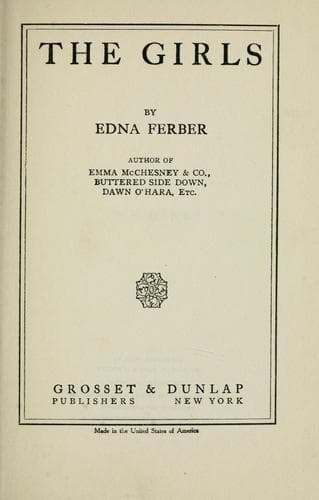
Chicago (Ill.) -- Fiction; Families -- Fiction; Women -- Fiction; World War, 1914-1918 -- Fiction
There was a curious scene with great-aunt Charlotte. At news of Jesse
Dick's death she had summoned Charley; had insisted that she must
see her; had been so mysteriously emphatic that Charley had almost
rebelled, anticipating a garrulous hour of senile sympathy and decayed
advice. Still she went, ascended the stairs to Aunt Charlotte's room
(she came downstairs more and more rarely now) and at Aunt Charlotte's
first words, "I knew he'd never come back, Charley," would have fled
incontinently if something in the grim earnestness of the black-browed
old countenance had not held her. There was no soft sentimentality
in great-aunt Charlotte's word or look. Rather she seemed eager,
vitalised, as though she had an important message to convey. Charley
did groan a little, inwardly, when Aunt Charlotte brought out the
yellow old photograph of the girl in the full-skirted wasp-waisted
riding habit, with the plume and the rose. And she said vaguely, "Oh,
yes," as she took it in her hand, and wished that she had not come. And
then, "Why, Aunt Charlotte! You lovely thing! You never showed me this
picture before! You're the family beauty. Your face is--the look--it
sort of glows----"
"Just for a little while. Jesse Dick brought that look to it."
"How do you mean--Jesse Dick?"
And quietly, masterfully, with the repression of more than fifty years
swept away before the urgence of this other Charlotte's need, she told
her own brief stark story. "I was eighteen, Charley, when the Civil War
began. That's the picture of me, taken at the time----"
Charley listened. Sometimes her eyes dwelt on the withered old
countenance before her; sometimes she looked down, mistily, at the
glowing face of the girl in the picture. But her attention never
wandered. For the first time she was hearing the story of the first
Jesse Dick. For the first time great-aunt Charlotte was telling it.
She was telling it, curiously enough, with the detachment of an
outsider--without reproach, without regret, without bitterness. When
she had finished she sat back and glanced about the bedroom--the neat,
shabby, rather close-smelling bedroom of an old, old woman--and then
she opened her hands on her knees, palms out, as though in exposition.
"And this is I," said the open palms and dim old eyes. "This is I,
Charlotte Thrift."
As though in answer--in defense of her--Charley leaned forward,
impetuously, and pressed her fresh young cheek against the sallow
withered one. "You've been wonderful, Aunt Charlotte. You have! What
would Grandma Payson have done without you!--or Lottie, or mother, for
that matter."
But great-aunt Charlotte shook her head. She seemed to be waiting for
something. And then Charley said, "I'll be all right. I'm the kind that
goes on. You know. I'm too curious about life to want to miss any of
it. I'll keep on trying things and people and I'll probably find the
combination. Not the perfect combination, like Jesse. You don't, twice.
But I suppose I'll marry--sometime."
Public-domain text, read in full here on John Shaqi.
Reviews
Reviews
No reviews yet
Be the first to share your thoughts on this work.
Elsewhere in the archive
Join the Discussion
Join the discussion
Sign in to leave a comment or review.
Sign InorCreate an account