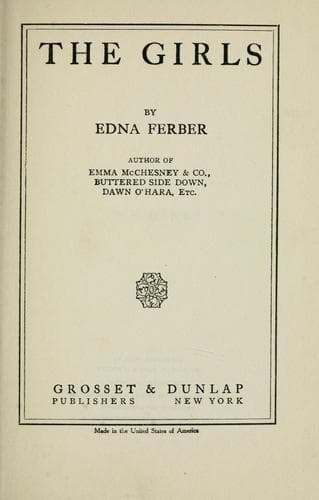
Chicago (Ill.) -- Fiction; Families -- Fiction; Women -- Fiction; World War, 1914-1918 -- Fiction
Lottie's homecoming had been a subdued affair. She had slipped back
into the family life of the old house on Prairie Avenue as if those
months of horror and exaltation and hardship had never been. But there
was a difference. Lottie was the head of the household now.
Mrs. Carrie Payson lay upstairs in the second-floor front bedroom, a
strangely flat outline beneath the covers of the great walnut bed. She
made a bad patient. The eyes in the pointed sallow face were never
still. The new nurse said, almost automatically now, "Don't try to
talk, Mrs. Payson. You want to save your strength."
"Strength! How can I ever get my strength lying here! I never stayed in
bed. I'll get up to-morrow, doctor or no doctor. Everything's going to
rack and ruin. I engaged the painters for the first of March. There's
repairing to do on everything in the spring. Did they send in the bill
for fixing the shed?"
But when next day came she threatened to get up to-morrow. And next
day. Her will still burned, indomitable, but the heart refused to do
its bidding. The thing they called rheumatism had leaped and struck
deep with claws and fangs, following a series of disturbing events.
Mrs. Payson had looked upon the Kemp's removal from the Hyde Park
apartment to the small Fifty-third Street flat as a family disgrace.
The Thrifts, she said, had always gone forward, never back. She tried
vainly to shake Henry's determination not to take advantage of the
roominess of the Prairie Avenue house. Henry had remained firm. He
had a position as manager of the china and glass department in a big
wholesale house whose specialty was the complete equipment of hotels,
restaurants, and country clubs. His salary was less than one-fourth
of what his income had been in the old days. He said it would have
to do. The Hyde Park Boulevard furnishings fitted strangely into the
cheap-woodwork-and-wall-paper background of the new apartment. Belle
refused to part with any of them. She said that some day they would be
back where they belonged. What she could not use she stored in the top
floor of her mother's house. By early spring she was white-enamelling
almost happily, and dickering with the dour landlord as to his possible
share of the expense of plain plaster in the living room. She had the
gift of making a house habitable in spite of herself.
Public-domain text, read in full here on John Shaqi.
Reviews
Reviews
No reviews yet
Be the first to share your thoughts on this work.
Elsewhere in the archive
Join the Discussion
Join the discussion
Sign in to leave a comment or review.
Sign InorCreate an account