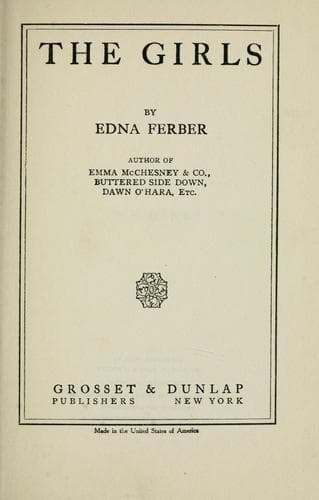
Chicago (Ill.) -- Fiction; Families -- Fiction; Women -- Fiction; World War, 1914-1918 -- Fiction
When the rest of the company was sleeping, or eating, or cooking messes
over furtive alcohol stoves in hotel bedrooms, Charley was prowling
about book-shops, or walking in the town's outskirts, or getting a
quiet private enjoyment out of its main street. She missed Lottie. She
often wanted to write her many of the things that the other members of
the family would not have understood. In the life and colour and beauty
she had craved she had found, as well, much drudgery, and sordidness
and hardship. But she loved the dancing. The shifting from town to
town, from theatre to theatre, numbed her pain. She caught herself
looking at beauty through Jesse Dick's eyes. In her Cincinnati letter
to Lottie she dismissed dancing in ten words and devoted three pages to
a description of the Nürnberg quality of the turreted buildings on the
hill overlooking the river, from the park. The money she earned, aside
from that which she needed for her own actual wants, she sent regularly
to the Red Cross. Before she had left, "I suppose I could be cutting
sandwiches," she had said, "and dancing with the kids passing through
Chicago; or driving an emergency car. I'd rather not. There are fifty
girls to every job of that kind."
Contrary to Aunt Charlotte's prediction, Jeannette's Nebraska sailor
had not become Jeannette's Nebraska husband until after the armistice.
She was married at Christmas and left for the West with him. The
wedding was held in the Prairie Avenue house. It turned out to be
rather a grim affair, in spite of Jeannette's high spirits and her
Bohemian relatives and the post-war reaction and the very good supper
provided by Mrs. Payson. For Belle and Henry thought of Charley; and
Mrs. Payson thought of Lottie; and Aunt Charlotte thought of both, and
of the girl of sixty years ago. And Jeannette said bluntly: "You look
as if it was a funeral instead of a wedding." She herself was a little
terrified at the thought of this great unknown prairie land to which
she was going, with her smart fur coat and her tricotine dress and her
silk stockings and gray kid shoes. As well she might be.
After it was over, an unnatural quiet settled down upon the house.
The two old women told each other that it was a blessed relief after
the flurry and fuss of the wedding, but looked at each other rather
fearfully during the long evenings and awaited Lottie's return with
such passionate eagerness as neither would have admitted to the other.
They expected her to pop in, somehow, the day after the armistice.
"Well, Lottie'll be home now," Mrs. Payson would say, "most any day."
She took to watching for the postman, as she used to watch at the
parlour window for Lottie on the rare occasions when she was late.
When he failed to appear at what she considered the proper time she
would fume and fuss. Then, at his ring, she would whisk into the front
vestibule with surprising agility and, poking her head out of the door,
berate him.
Public-domain text, read in full here on John Shaqi.
Reviews
Reviews
No reviews yet
Be the first to share your thoughts on this work.
Elsewhere in the archive
Join the Discussion
Join the discussion
Sign in to leave a comment or review.
Sign InorCreate an account