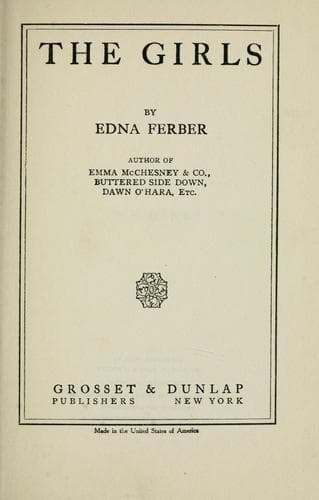
Chicago (Ill.) -- Fiction; Families -- Fiction; Women -- Fiction; World War, 1914-1918 -- Fiction
It is a terrible thing to see an old woman blush. The swift, dull
almost thick red surged painfully to great-aunt Charlotte's face
now, and her eyes were suddenly wide and dark, like a young girl's,
startled. Then the red faded and left her face chalky, ghastly. It was
as though a relentless hand had wrapped iron fingers around her heart
and squeezed it and wrenched it once--tight and hard!--and then relaxed
its grip. She peered at the boy standing there in the doorway; peered
at him with dim old eyes that tried to pierce the veil of years and
years and years. The others were talking. Charley had got her wraps
from the hall, and was getting into her galoshes. This cumbersome and
disfiguring footgear had this winter become the fad among university
co-eds and South Side flappers. They wore galoshes on stormy days
and fair. The craze had started during a blizzardy week in January.
It was considered chic to leave the two top clasps or the two lower
clasps open and flapping. The origin of this could readily be traced to
breathless co-eds late for classes. All young and feminine Hyde Park
now clumped along the streets, slim silken shins ending grotesquely in
thick black felt-and-rubber.
Jesse Dick stooped now to assist in the clasping of Charley's galoshes.
He was down on one knee. Charley, teetering a little, put one hand on
his head to preserve her balance. He looked up at her, smiling; she
looked down at him, smiling. Almost sixty years of life swept back over
great-aunt Charlotte Thrift and left her eighteen again; eighteen, and
hoop-skirted in her second-best merino, with a green-velvet bonnet and
a frill of blond lace, and little muddied boots and white stockings.
She could not resist the force that impelled her now. She got up from
her corner and came over to them. The talk went on in the living room.
They did not notice her.
"I knew your--I knew a Jesse Dick," she said, "years ago."
The boy stood up. "Yes? Did you?"
"He died in the Civil War. At Donelson. He was killed--at Donelson."
The boy spatted his hands together a little, briskly, to rid them of a
bit of dried mud that had clung to the galoshes. "That must have been
my grandfather's brother," he said politely. "I've heard them speak of
him."
He had heard them speak of him. Charlotte Thrift, with seventy-four
years of a ruined life heavy upon her, looked at him. He had heard them
speak of him. "Pomroy Dick? Your grandfather? Pomroy Dick?"
"Why, yes! Yes. Did you know him, too? He wasn't--we Dicks aren't--How
did you happen to know him?"
"I didn't know your grandfather Pomroy Dick," said Great-aunt
Charlotte, and smiled so that the withered lips drew away from the
blue-white, even teeth. "It was Jesse I knew." She looked up at him.
"Jesse Dick."
Charley leaned over and pressed her fresh dewy young lips to the
parchment cheek. "Now isn't that interesting! Good-bye dear." She
stopped and flashed a mischievous glance at the boy. "Was he a poet
too, Aunt Charlotte?"
"Yes."
Public-domain text, read in full here on John Shaqi.
Reviews
Reviews
No reviews yet
Be the first to share your thoughts on this work.
Elsewhere in the archive
Join the Discussion
Join the discussion
Sign in to leave a comment or review.
Sign InorCreate an account