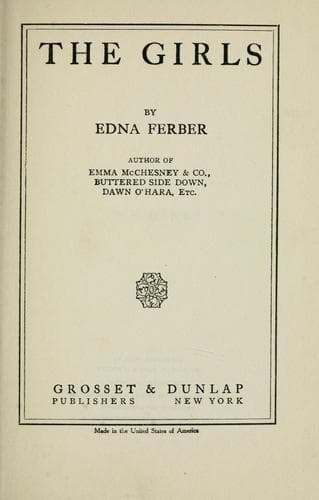
Chicago (Ill.) -- Fiction; Families -- Fiction; Women -- Fiction; World War, 1914-1918 -- Fiction
"Oh! Does your mother know?"
"No. I just--I just brought her home." Lottie put a hand on Aunt
Charlotte's withered cheek. She was terribly near to tears. "Dear
Aunt Charlotte, won't you take care of Jeannette; I'm going out after
mother. Show her her room--upstairs; you know. And give her some hot
lunch. On the third floor you know--the room."
Jeannette spoke up, primly. "I don't want to make nobody trouble."
"Trouble!" echoed Aunt Charlotte. She rose spryly to her feet, asked no
explanation. "You come with me, Jeannette. My, my! How pretty your hair
is cut short like that. So Gussie is your sister, h'm? Well, well." She
actually pinched Jeannette's tear-stained cheek.
"The dear thing!" Lottie thought, harassed as she was. "The darling old
thing!" And then, suddenly: "_She_ should have been my mother."
Lottie ran downstairs and into the electric. She jerked its levers so
that the old vehicle swayed and cavorted on the slippery pavement.
She would drive straight over to the one-story buildings on west
Halsted, near Eighteenth. Her mother usually went there first. It was
a Polish settlement. Mrs. Payson owned a row of six stores occupied
by a tobacconist, a shoemaker, a delicatessen, a Chinese laundry, a
grocer, a lunch room. She collected the rents herself, let out bids for
repairs, kept her own books. Lottie had tried to help with these last
but she was not good at accounts. Unless carefully watched she mixed
things up hopelessly. Mrs. Payson juggled account books, ledgers, check
books, rental lists like an expert accountant. Eighteenth Street, as
Lottie drove across it now, was a wallow of liquid mud, rain, drays,
spattered yellow street-cars, dim drab-looking shops. The slippery
car tracks were a menace to drivers. She had to go slowly. The row of
Halsted Street buildings reached at last, Lottie ran in one store and
out the other.
"Is my mother here?"
"She's gone."
"Has Mrs. Payson been here?"
"Long. She left an hour ago."
There were the other buildings on Forty-third Street. But she couldn't
have gone way up there, Lottie told herself. But she decided to try
them. On the way she stopped at the house. Her mother had not yet
come in. She went on up to Forty-third, the spring rain lashing the
glassed-in hood of the electric. Yes, her mother had been there and
gone. Lottie was conscious of a little hot flame of anger rising,
rising in her. It seemed to drum in her ears. It made her eyelids smart
and sting. She set her teeth. She swung the car over to Gus's market on
Forty-third. Her hands gripped the levers so that the ungloved knuckles
showed white.
"It's a damned shame, that's what it is!" she said, aloud; and sobbed a
little. "It's a damned shame, that's what it is. She could have waited.
It's just pure meanness. She could have waited. I wish I was dead!"
It was as though the calm, capable, resourceful woman of the ten
o'clock court room scene had never been.
"Gus, has my mother----?"
Public-domain text, read in full here on John Shaqi.
Reviews
Reviews
No reviews yet
Be the first to share your thoughts on this work.
Elsewhere in the archive
Join the Discussion
Join the discussion
Sign in to leave a comment or review.
Sign InorCreate an account