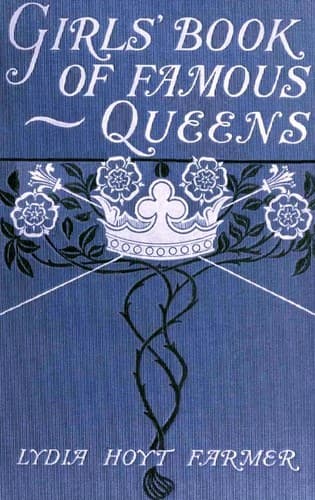
The Girls' Book of Famous QueensFarmer, Lydia Hoyt
History
The Girls' Book of Famous Queens
Farmer, Lydia Hoyt
Queens -- Biography -- Juvenile literature
On being conducted with much pomp to the royal apartments in the Tower,
attended by an immense concourse of people who graciously greeted her,
she remarked upon entering the well-remembered Tower where she had once
been received through the traitor’s gate as a prisoner, but now entered
the royal palace as acknowledged sovereign: “Some have fallen from
being princes in this land to be prisoners in this place. I am raised
from being prisoner in this place to be a prince of this land; so I
must yield myself thankful to God and merciful to man, in remembrance
of the same.” She was crowned on the 15th of January, 1558, with great
splendor. Upon the morning after her coronation, as she was proceeding
to chapel, one of her courtiers cried out with loud voice, requesting
that four or five prisoners might be released. Upon the queen’s asking
whom these prisoners might be, he replied: “The four Evangelists and
the Apostle St. Paul, who have been long shut up in an unknown tongue,
and are not able to converse with the people.”
Elizabeth answered this strange appeal by remarking: “It is best to
inquire of them whether they approve of being released or not.”
The result of a convocation held for the discussion of this subject was
a new translation for common use.
In the first session of Parliament a deputation was sent to Queen
Elizabeth at Whitehall, requesting that her Grace might think of
marriage, to which Elizabeth replied:
“In a thing which is not very pleasing to me, the infallible testimony
of your good will and all the rest of my people is most acceptable. As
concerning your eager persuasion of me to marriage, I must tell you
I have been ever persuaded that I was ordained by God to consider,
and above all, to do those things which appertain to his glory. And
therefore it is that I have made choice of this kind of life. To
conclude, I am already bound unto a husband, which is the kingdom of
England, and let that suffice you;” saying which she extended her
finger upon which she wore the ring with which the ceremony of her
coronation had been performed. This same demand of the Parliament
was subsequently repeated many times, but until the end of her life
Elizabeth took pleasure in keeping England and the world in suspense
by her grave coquetries, which from time to time betokened a probable
marriage which she herself never apparently desired. Proposals for her
hand poured in from every court of Europe, but though she entertained
some of them for a time, she always managed to break them off in the
end. The man whom she probably really desired to marry after she became
queen was her favorite Dudley, whom she afterwards created Earl of
Leicester. So great was her evident fancy for this man that she might
have consented had he been free; and when the sudden and suspicious
death of his wife left his hand at her disposal, the horror of the
people who believed him guilty of wife-murder restrained her from thus
lowering her queenly dignity.
Public-domain text, read in full here on John Shaqi.
Reviews
Reviews
No reviews yet
Be the first to share your thoughts on this work.
Elsewhere in the archive
Join the Discussion
Join the discussion
Sign in to leave a comment or review.
Sign InorCreate an account