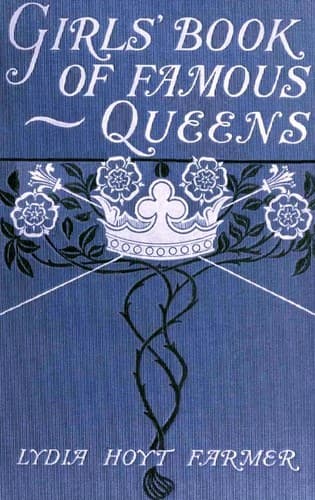
The Girls' Book of Famous QueensFarmer, Lydia Hoyt
History
The Girls' Book of Famous Queens
Farmer, Lydia Hoyt
Queens -- Biography -- Juvenile literature
“Elizabeth could talk poetry with Spenser and philosophy with Bruno;
she could discuss euphuism with Lyly, and enjoy the chivalry of Essex;
she could turn from talk of the latest fashions, to pore with Cecil
over despatches and treasury books; she could pass from tracking
traitors with Walsingham, to settle points of doctrine with Parker, or
to calculate with Frobisher the chances of a northwest passage to the
Indies. The versatility and many-sidedness of her mind enabled her to
understand every phase of the intellectual movement of her day, and
to fix by a sort of instinct on its higher representatives. But the
greatness of the queen rests above all on her power over her people. We
have had grander and nobler rulers, but none so popular as Elizabeth.
It was only on her intellectual side that Elizabeth touched the England
of her day. All its moral aspects were simply dead to her. She made her
market with equal indifference out of the heroism of William of Orange
or the bigotry of Philip. The noblest aims and lives were only counters
on her board. No woman ever lived who was so destitute of the sentiment
of religion. While the world around her was being swayed more and more
by theological beliefs and controversies, Elizabeth was absolutely
untouched by them.”
For nineteen long years Queen Elizabeth kept the beautiful Mary,
Queen of Scots, in captivity, without right or reason, Mary Stuart’s
defenders declare; but Elizabeth’s upholders claim that Mary was guilty
of many plots against the English Queen.
It is almost impossible to tread the mazy paths of this epoch with
impartial glance and unbiassed opinions. The writers on both sides
of these knotty questions are able and apparently conscientious. We
can but state both sides, and leave the reader to form his or her own
opinion.
That Mary, Queen of Scots, could have been subjected to all the
terrible trials and awful accusations which fell upon her seemingly
defenceless head and still be entirely innocent of the crimes alleged
against her, is quite possible, considering her peculiar situation and
the selfish hatred of her enemies; yet those who believe in her guilt
bring forth very strong evidence to prove that she connived at murder,
and willingly gave herself into the power of the murderer.
This seems too atrocious to claim regarding a woman of the otherwise
winning and kindly character of Mary, Queen of Scots. When two entire
nations,—and one of them governed by a keen-witted, dissembling, and
weakly-jealous queen,—are joined to destroy one poor helpless woman,
and that woman a prisoner in the hands of her enemies, with spies at
every keyhole and adversaries on every side, hoping to raise themselves
to power by her destruction,—it is hardly to be wondered at that
evidence can be found or forged which shall aid them in overwhelming
her in ruin and at length in death.
Public-domain text, read in full here on John Shaqi.
Reviews
Reviews
No reviews yet
Be the first to share your thoughts on this work.
Elsewhere in the archive
Join the Discussion
Join the discussion
Sign in to leave a comment or review.
Sign InorCreate an account