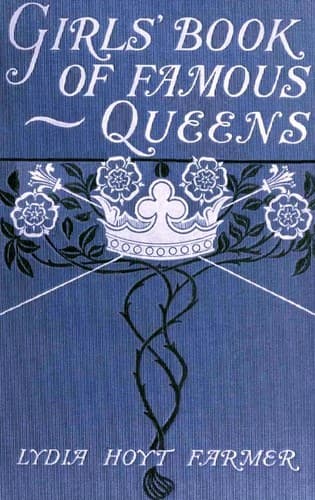
The Girls' Book of Famous QueensFarmer, Lydia Hoyt
History
The Girls' Book of Famous Queens
Farmer, Lydia Hoyt
Queens -- Biography -- Juvenile literature
“She was dressed in a robe whiter than the lily, but so glorious in its
fashion and decorations, that it would be difficult, nay impossible,
for any pen to do justice to its details. Her regal mantle and train
were of bluish-grey cut velvet, richly embroidered with white silk
and pearls. It was of a marvellous length, full six toises, covered
with precious stones, and was supported by young ladies. Mary wore
a royal crown on this occasion far more costly than any previous
Scottish monarch could ever boast, composed of the finest gold and most
exquisite workmanship, set with diamonds, pearls, rubies, and emeralds
of inestimable worth, having in the centre a pendent stone computed at
five hundred thousand crowns. About her neck hung a matchless jewel,
suspended by chains of precious stones, which, from its description,
must have been none other than that well known in Scottish records
by the familiar name of the _Great Harry_. This was her own personal
property, derived from her royal English great-grandfather, Henry VII.,
by whom it was presented to her grandmother, Queen Margaret Tudor.”
Nôtre Dame blazed with lights, dazzling jewels, and _grande toilettes_.
As the ceremony was concluded, Mary greeted her husband as Francis
I., king of Scotland; and all the Scottish nobles bent in homage to
him. Handfuls of gold and silver coin were then thrown in the midst
of the assembled crowds of people, while French heralds proclaimed
the marriage, and cried, “Largesse, largesse!” and the royal couple
received the titles of “Queen-Dauphiness,” and “The King Dauphin.”
Magnificent banquets, gorgeous balls, and splendid pageants succeeded
the marriage ceremonies in the church. The royal palace was decorated
with superb splendor and regal lavishness of display. At the grand ball
the beautiful bride, the dazzling queen of Scotland, danced the stately
pavon,—a kind of minuet, which was performed by ladies alone. As her
train was twelve yards long, and was borne after her by a gentleman,
following her in the dance, it was a difficult exercise of grace and
skill for the young bride to achieve. After the dance, a novel pageant
took place in the grand _salon_. Suddenly there issued from the Chamber
of Requests six gallant ships, with sails of silver gauze fastened to
silver masts. Seated on the deck of each vessel, which was propelled by
artificial means, was a prince attired in cloth of gold. Each handsome
prince wore a mask; and as the ship sailed by the groups of ladies,
the chivalrous knight seized a maiden and placed her on the gorgeous
throne beside him. In this exciting game the Dauphin caught his bride,
the lovely Mary Stuart. But Prince de Condé, champion of the Huguenots,
caused great merriment by capturing, as his lady, the wife of his
opponent of Romish faith, the Duke de Guise.
Public-domain text, read in full here on John Shaqi.
Reviews
Reviews
No reviews yet
Be the first to share your thoughts on this work.
Elsewhere in the archive
Join the Discussion
Join the discussion
Sign in to leave a comment or review.
Sign InorCreate an account