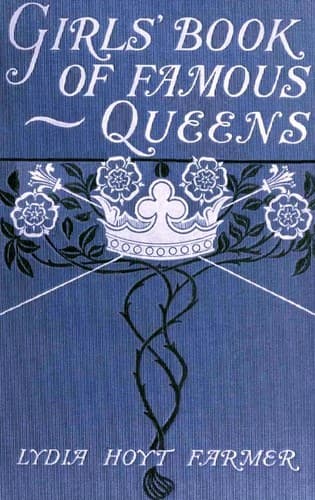
The Girls' Book of Famous QueensFarmer, Lydia Hoyt
History
The Girls' Book of Famous Queens
Farmer, Lydia Hoyt
Queens -- Biography -- Juvenile literature
“A startling light is thrown by a careful collation of the above
letters of Randolph to Leicester and Throckmorton on the agency,
as well as the incentives, employed in the successive Edinburgh
assassinations of Mary Stuart’s faithful and incorruptible minister,
David Rizzio, in March, 1566, and that of her husband in February,
1567, which led to the deposition of that unfortunate princess and
the transfer of the government of Scotland to the sworn creatures
of the English sovereign, a _great_ but _diabolical stroke of
policy_. The cool revelation of our unscrupulous ambassador, that
the faithful minister who would not barter his royal mistress’s
interests for English gold, ‘would have his throat cut within ten
days,’ is sufficient proof of his iniquitous coalition in the murderous
confederacy against the first victim of the English cabinet. His
hostile expressions regarding Mary’s husband, with whom he was at
that very moment enleagued in the secret intrigues for obtaining
the signatures of Murray and the banished lords to the bond for the
murder of Rizzio, are no less worthy of observation, together with his
earnest deprecation of Mary and her husband ever succeeding to the
throne of England, and the emphatic desire he expressed to Throckmorton
that ‘_something may be done to preclude the possibility of such a
contingency_.’
“This subtle diplomatist first excited and then worked on the natural
fears of better men than either himself, Leicester, or Throckmorton,
to wink at, if not to sanction, the systematic train of political
villany to which David Rizzio, Henry Stuart, and Mary Stuart were the
successive victims. After the consummation of these astute schemes of
wickedness—when Rizzio and Darnley were festering in their untimely
graves, and the more pitiable survivor, Mary Stuart, languishing in her
damp, noisome prison-room in Tutbury Castle, her infant son set up as
a puppet king, to color the usurpation of the murderers of his father
and her defamers, and her realm convulsed with civil strife—‘then,’
observes Sir James Melville, ‘as Nero stood upon a high part of Rome to
see the town burning, which he had caused to be set on fire, so Master
Randolph delighted to see such fire kindled in Scotland, and by his
writings to some in the court of England, glorified himself to have
brought it to pass in such sort that it could not be easily _slokened_
(slaked) again.’”
In proof of the importance of this link in the chain of evidence, we
will quote Mr. Froude’s own words: “As the vindication of the conduct
of the English government proceeds on the assumption of her guilt,
so the determination of her innocence will equally be the absolute
condemnation of Elizabeth and Elizabeth’s advisers.”
There is only one other point in this evidence for and against the
guilt of Mary Stuart, which will be cited. Regarding the famous
confessions of Paris, Mr. Froude says:—
Public-domain text, read in full here on John Shaqi.
Reviews
Reviews
No reviews yet
Be the first to share your thoughts on this work.
Elsewhere in the archive
Join the Discussion
Join the discussion
Sign in to leave a comment or review.
Sign InorCreate an account