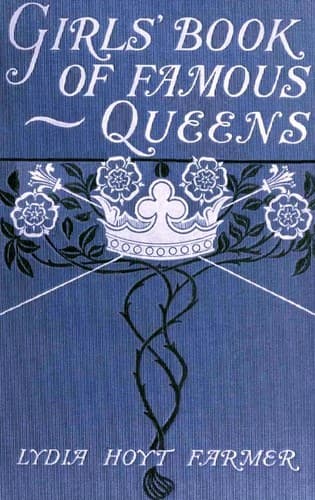
The Girls' Book of Famous QueensFarmer, Lydia Hoyt
History
The Girls' Book of Famous Queens
Farmer, Lydia Hoyt
Queens -- Biography -- Juvenile literature
Even the horrors of the Inquisition in Spain pale before the horrors
of the massacre of St. Bartholomew. Even the bloody “Demon of the
South,” as Philip II. was called, seems not such a revolting spectacle
of depraved humanity as Catherine de’ Medici; for Philip, at least,
fanatically imagined he was aiding the cause of religion, as he
believed the infamous Inquisition to be a righteous avenger in behalf
of the Catholic Church; whereas Catherine de’ Medici had no belief, no
religion, cared neither for Catholics nor Protestants, neither for the
Romish Church nor for the Reformed Faith.
She flattered each by turns as it best suited her nefarious schemes;
she was actuated by no motive beyond her personal ambition of holding
the reins of power; she cared not who or what was sacrificed, whether
the life and soul of her own child, or whether the result was the
downfall of every religious belief, the blood of her subjects, the ruin
of her provinces, and the desolation of the homes of her people.
Not even fanaticism can be offered as a poor excuse for her crimes; her
infamous deeds can be cloaked by no paltry plea of religious fervor.
Her crimes were instigated by her own diabolical soul, a willing ally
of the Prince of Darkness; and were it not for the strong menial
abilities she manifested, one would imagine her some grotesque monster
of an animal. But her crafty schemes betokened keen intellectual
powers, and made her seem some malignant demon in human shape sent
forth from the lowest depths of the Inferno to lure men and women to
destruction.
Catherine de’ Medici was a daughter of Lorenzo de’ Medici, that ruler
of Florence for whom Machiavelli wrote the “Prince.” Having lost both
her parents in early childhood, Catherine was sent to a convent to be
educated. Her uncle, Pope Clement VII., arranged with Francis I. of
France a marriage between Catherine and the Duke of Orleans, afterwards
Henry II. of France. This marriage was celebrated in 1533, when
Catherine was fourteen years of age.
During the reign of Francis, Catherine exercised no influence in
France. She was a thick-set, plain, unprepossessing girl; and being so
young, and a foreigner, and a native of a state having no great weight
in the world of politics, she was thrown entirely into the shade by
more important and attractive personages, having not yet given any
proof of her after great but iniquitous ability.
Public-domain text, read in full here on John Shaqi.
Reviews
Reviews
No reviews yet
Be the first to share your thoughts on this work.
Elsewhere in the archive
Join the Discussion
Join the discussion
Sign in to leave a comment or review.
Sign InorCreate an account