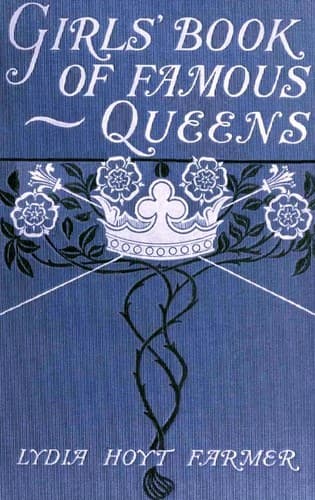
The Girls' Book of Famous QueensFarmer, Lydia Hoyt
History
The Girls' Book of Famous Queens
Farmer, Lydia Hoyt
Queens -- Biography -- Juvenile literature
The Emperor Charles was also amazed at this time by the gorgeousness
and extravagance in dress displayed by the _bourgeoisie_. “At Poitiers
he was received by near five hundred gentlemen, richly attired, and
two thousand of the citizens in robes of velvet and satin, bordered
with gold and silver lace. From Orleans a still more imposing cavalcade
rode out to meet him. The _bourgeoisie_ of this royal city had certain
privileges which, like the citizens of Paris, they shared with the
nobility. Ninety-two of these privileged merchants of the upper
_bourgeoisie_ accompanied the governor and persons of distinction to
greet the emperor. All of them were mounted on excellent chargers,
and all wore coats or casaques of black velvet, and doublets or vests
of white satin fastened with gold buttons. Their boots were of white
morocco, slashed, and their spurs either silver-gilt or gold. Their
caps or toques were also of velvet, elaborately ornamented with gold
embroider and precious stones.”
Orleans was then considered a large, handsome town. Charles V. said
it was the finest city he saw in France. “Where, then,” he was asked,
“does your majesty place Paris?”
“Oh, Paris,” he replied, “is no city, but rather a little world.”
As Francis I. was ruled by his favorite, the _Duchesse d’ Étampes_,
his wife, Queen Eleanor, was simply a dazzling ornament in his court,
where she always appeared in the splendor of the most gorgeous attire,
solacing herself with the only privilege left to her, of displaying her
rightful rank and prestige. “Near her, as if to seek the protection
which her position afforded, if not her influence,—for of that she had
none,—the quiet, subtle girl-wife of the youthful Prince Henry was
always to be found. Of all that passed around her nothing escaped her
vigilant, restless eyes. She was inwardly taking notes to serve for
her guidance in the future,—resigned to live, and learn, and bide her
time, fully assured—for was it not written in the stars?—that, as time
rolled on, her turn would come to sway the destinies of the kingdom.
“No attentions did Catherine de’ Medici receive or look for from
her boy-husband. He was a fluttering captive in the chains of first
love, and the most brilliant beauty of the court, the famed _Diana de
Poitiers_, was the lady of his heart, at the shrine of whose loveliness
he bowed the knee. Prince Henry was then seventeen, and the lady had
numbered thirty-seven summers. As to winters, they glided o’er her
smooth, fair brow, leaving no trace of their passage, or any snowy
signs of age on her luxuriant raven hair. Her husband, the Comte de
Dreux-Brezé, died in 1531, and she erected a magnificent monument to
his memory, and ever after wore the widow’s dress. Nature had made her
beautiful forever, and beautiful she remained, unaided by art, we are
told, until the end of her threescore years and nine.
Public-domain text, read in full here on John Shaqi.
Reviews
Reviews
No reviews yet
Be the first to share your thoughts on this work.
Elsewhere in the archive
Join the Discussion
Join the discussion
Sign in to leave a comment or review.
Sign InorCreate an account