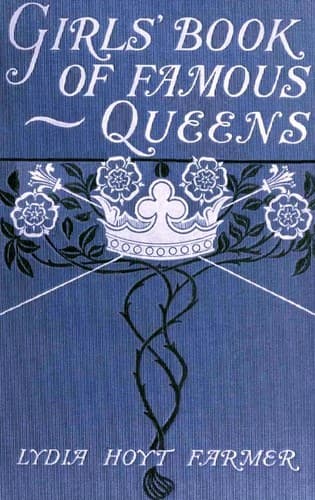
The Girls' Book of Famous QueensFarmer, Lydia Hoyt
History
The Girls' Book of Famous Queens
Farmer, Lydia Hoyt
Queens -- Biography -- Juvenile literature
France had been for nearly six years free from actual war with the
emperor, when the German princes sought the aid of Henry II. in an
alliance against Charles V., who was threatening to become as despotic
in Germany as he was in Spain. The German princes had proposed to give
Henry II. possession of the three cities, Metz, Toul, and Verdun, or
at least allow him to conquer them, as these cities were not Germanic
in language. As a further inducement to the French king to make an
alliance with them, they promised to aid him in endeavoring to recover
from Charles, Henry’s heritage of Milan. This had been the constant
ambition of Francis I., to obtain possession of this ancestral
heritage. Henry accordingly entered into negotiations with the German
Princes; and to the declaration of war of Maurice of Saxony against the
Emperor Charles, was appended a manifesto from the king of France.
“Therein Henry announced himself the ‘Defender of the liberties of
Germany, and protector of her captive princes,’ further stating, ‘that
broken-hearted (_le cœur navré_) at the condition of Germany, he could
not refuse to aid her, but had determined to do so to the utmost of his
power and ability, even to personally engaging in this war, undertaken
for liberty, and not for his personal benefit.’ This document, written
in French, was headed by the representation of a cap between two
poniards, and around it the inscription, ‘The emblem of liberty.’
It is said to have been copied from some ancient coins, and to have
been appropriated as the symbol of freedom by Cæsar’s assassins. Thus
singularly was brought to light by a king of the French Renaissance
that terrible _cap of liberty_, before which the ancient crown of
France was one day destined to fall.”
Henry II., thereupon leaving Catherine de’ Medici as regent in France,
much to her profound surprise at such unusual attention from her
indifferent husband,—who took good care, however, to tie her hands by
such restrictions that she was regent only in name, while Diana held
the real power,—departed with his army, and with ease took possession
of the cities of Metz, Toul, and Verdun.
It was in endeavoring to reconquer Metz that Charles V. met his
disastrous repulse in the brave defence of the Duke of Guise, who was
then governor of Metz.
After the fatigues and horrors of war, the French court turned again to
balls and tournaments, and the building of châteaux, and the patronage
of art. It was at this time that Bernard Palissy was much patronized
by the fair Diana, whom Henry had made _Duchesse de Valentinois_,
presenting her with the _Château de Chenonceaux_, which seemed to be
the only attention from the king which caused Catherine de’ Medici to
vow vengeance, as she had desired to possess the château herself.
Notwithstanding desolating wars, the French court of Henry II. far
outshone that of Francis I. in extravagance of dress and living.
Public-domain text, read in full here on John Shaqi.
Reviews
Reviews
No reviews yet
Be the first to share your thoughts on this work.
Elsewhere in the archive
Join the Discussion
Join the discussion
Sign in to leave a comment or review.
Sign InorCreate an account