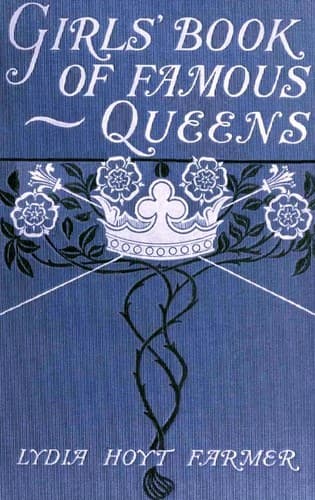
The Girls' Book of Famous QueensFarmer, Lydia Hoyt
History
The Girls' Book of Famous Queens
Farmer, Lydia Hoyt
Queens -- Biography -- Juvenile literature
Sixteen years from that time the Duke of Guise was himself
assassinated, and received a kick in the face from Henry III., the
brother of Charles IX., in whose service he was performing these
diabolical deeds.
The streets everywhere resounded with the cries of “Kill! kill!”
At the commencement of the carnage, the queen of Navarre was awakened
by a cry at her door: “Navarre! Navarre!” Supposing it was her husband,
she ordered her attendants to open the door, whereupon a bleeding
Huguenot rushed to her bedside and clasped the queen’s arm, begging for
his life. He was followed by Catholic soldiers; but at the entreaty
of the princess his life was spared. Words are weak to describe the
horrors of that direful night. Gory bodies were suspended from the
windows; the dead were piled in heaps in the streets; the pavements
were slippery with the streaming blood; human heads were kicked as
footballs along the boulevards, by the bestial fiends who had become
frenzied with the sight of blood. And in the midst of this awful scene
of terror, priests paraded in their sacerdotal robes, bearing aloft
the crucifixes, and shouting their blasphemous hymns of rejoicing,
and inciting the demoniacal murderers to fresh deeds of hellish hate.
Catholic nobles and generals rode through the streets with gorgeous
retinues, and called upon the people to wreak their vengeance upon the
helpless Protestants. For a whole week the massacre continued, and it
is estimated that one hundred thousand Protestants perished throughout
the kingdom.
When the morning was well advanced, Catherine, Charles, and a
profligate band of lords and ladies walked through the reeking streets,
and gazed with calmness and satisfaction upon the heaps of dead piled
up before the Louvre; and they even indulged in ribald jest and
merriment.
The Catholic pulpits resounded with exultant harangues after this
hellish work was ended, and in honor of the event a medallion was
struck off, with the inscription, “_La Piété a reveillé la Justice_.”
From every part of Protestant Europe arose a cry of horror. Queen
Elizabeth shrouded her court in mourning, and refused to give audience
to the French ambassador, who exclaimed in mortification and chagrin,
“I am ashamed to acknowledge myself a Frenchman.”
But Philip of Spain, the “Demon of the South,” wrote to the infamous
Catherine de’ Medici:—
“These tidings are the greatest and the most glorious I could have
received.”
Amid all the fiend-like deeds of men on earth, the awful Massacre of
St. Bartholomew stands without a parallel.
The massacre of the priests of France during the dreadful tragedy of
the Revolution was human retaliation. In the mysterious providence of
God, the “iniquities of the fathers are visited upon the children.”
“The 24th of August, 1572, and the 2d of September, 1792, though far
apart in the records of time, are consecutive days in the government of
God.”
Public-domain text, read in full here on John Shaqi.
Reviews
Reviews
No reviews yet
Be the first to share your thoughts on this work.
Elsewhere in the archive
Join the Discussion
Join the discussion
Sign in to leave a comment or review.
Sign InorCreate an account