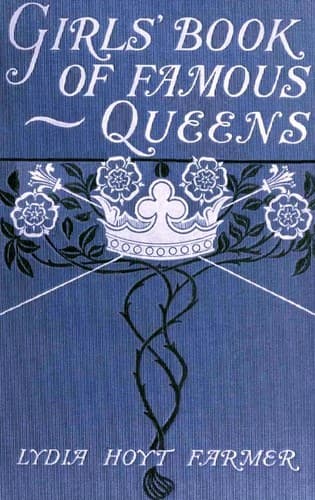
The Girls' Book of Famous QueensFarmer, Lydia Hoyt
History
The Girls' Book of Famous Queens
Farmer, Lydia Hoyt
Queens -- Biography -- Juvenile literature
There was little of the pomp and ceremony which distinguished the
court of the proud Elizabeth; indeed, Anne herself was too careless
and dull-witted, and the imperious Duchess of Marlborough was too
defiant of all restraints to have insured that subservient obeisance
which Elizabeth demanded and received. Having been obliged, even in
her coronation procession, to be borne in a low arm-chair on account
of her gout, which prevented her walking in regal majesty as all her
predecessors had done, she continued subject to this infirmity, which
her gross eating and drinking greatly increased. The stormy disputes
between her ministers, Oxford and Bolingbroke, became so violent that
at length the fear of having to submit to a third terrible council
with them, after two hot disputes had been interrupted by her attacks
of violent illness, caused a burning fever, which threatened her
life. Submitting to the old remedy of bleeding, she was found to be
no better, and it was evident that her end was near. Oxford having
resigned his office of lord treasurer in a rage, it became necessary
to appoint some one in his place. The Duke of Shrewsbury was suggested
for the office, but he would not accept the staff unless the queen
herself laid it in his hand. Accordingly the white wand was placed in
the stiffening fingers of the dying queen, and the Duke of Shrewsbury,
approaching her bedside, asked:—
“Do you know to whom you give the white wand?”
“Yes,” murmured the still-conscious queen; “to the Duke of Shrewsbury;
and for God’s sake, use it for the good of my people!”
Thus perished the last of the sovereigns of the House of Stuart.
“The British sovereign is dead and the throne is vacant,” were the few
but expressive words sent to George of Hanover; and without opposition,
King George I. ascended the throne of Great Britain.
MARIA THERESA.
A.D. 1717-1780.
“’Tis beauty that doth oft make women proud;
’Tis virtue that doth make them most admir’d;
’Tis government that makes them seem divine.”
—SHAKESPEARE.
ON the 13th of May, 1717, in the royal palace at Vienna, a baby
princess first opened her wondering eyes upon this world, in whose
history she was destined to play an important, and what is still
better, a highly commendable part. This illustrious infant was
christened by the titles, Maria Theresa Valperga Amelia Christina.
Her father was Charles VI. of Austria, emperor of Germany. Lady Wortley
Montagu, who, as Mary Pierrepont, had figured as one of the young
ladies appointed to bear the train of Queen Anne during her coronation
ceremony, afterwards visited the court of Vienna, shortly before the
birth of Maria Theresa, and describes the mother of that princess, the
lovely Elizabeth Christina of Brunswick, as an empress of sweet and
gracious manners and amiable character.
Public-domain text, read in full here on John Shaqi.
Reviews
Reviews
No reviews yet
Be the first to share your thoughts on this work.
Elsewhere in the archive
Join the Discussion
Join the discussion
Sign in to leave a comment or review.
Sign InorCreate an account