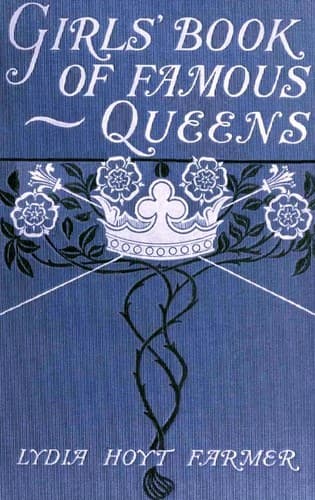
The Girls' Book of Famous QueensFarmer, Lydia Hoyt
History
The Girls' Book of Famous Queens
Farmer, Lydia Hoyt
Queens -- Biography -- Juvenile literature
Isabella of Castile stands nearer to Maria Theresa in individual
greatness than any of the other famous queens. We have not included
a sketch of her life in this volume, because her history is so
indissolubly intertwined with that of Ferdinand V. of Spain; and in
giving his life in the companion book of “Famous Rulers,” we also there
outlined a brief sketch of Isabella of Castile.
Maria Theresa is the most illustrious example of an “imperial woman of
business.” She was big-brained and energetic, having none of the mental
weaknesses of voluptuous natures. Lacking thereby, perhaps, somewhat
in warm emotions, but by her own inherent nature she was exempted
from falling into error. She was a model of virtue both in public and
private life.
“Maria Theresa was an embodiment of executive regality. She had the
promptitude, forethought, and vigilance of a detective officer, and
discharged duty with the rigid precision of a policeman. She was
essentially practical, and thoroughly industrious-minded. She was
ready in an emergency, equal to a difficulty, and sturdy for order and
regulation. She met reverses with boldness and fortitude, and used
prosperity for instituting reforms. She was greatly remedial, remedying
sudden mischances by encountering them firmly, and remedying existing
evils with the strong hand of eradication.”
Frederick the Great, although politically her foe, said of her:
“Although I have made war against her, I have never been her personal
enemy. I have always respected her; she was an honor to her sex, and
the glory of her throne.”
Maria Theresa was not only immaculately virtuous herself, but she
enforced the strictest rule of moral and decorous demeanor both in
her court and throughout her dominions. Rigorous etiquette and staid
decorum were marked features of her imperial household and her own
conduct. Only once did she deign to notice one of profligate notoriety
when she desired to enter into friendly alliance with France, she found
the effeminate Louis XV. unwilling to listen to the proposals of her
ambassador. Well knowing where the chief influence over the mind of
this weak king could be reached, she condescended to write a letter
to Madame de Pompadour, with the courteous address “_Ma Chère Amie_.”
This produced the expected effect. Madame de Pompadour’s self-love and
vanity were so much flattered by such a mark of attention from the
imperial Maria Theresa, that, employing her most seductive arts, she
won the consent of Louis XV. to enter into an alliance with Austria.
But this political policy must have cost the pure and exalted character
of Maria Theresa a sharp pang of personal mortification.
Public-domain text, read in full here on John Shaqi.
Reviews
Reviews
No reviews yet
Be the first to share your thoughts on this work.
Elsewhere in the archive
Join the Discussion
Join the discussion
Sign in to leave a comment or review.
Sign InorCreate an account