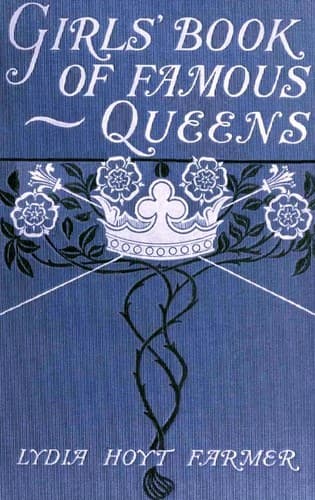
The Girls' Book of Famous QueensFarmer, Lydia Hoyt
History
The Girls' Book of Famous Queens
Farmer, Lydia Hoyt
Queens -- Biography -- Juvenile literature
The news of his death was announced to the empress as she was on the
point of holding her court, but, as the proper precautions had not
been taken, she did not choose to make it public, and went on with
her audience with every appearance of cheerfulness and tranquillity.
On the following day, while dining in public, the death of the Czar
was formally announced; and immediately she rose from the table, all
bathed in tears, and retired to her apartment, where for several days
she feigned the greatest grief. She afterward published a manifesto,
in which she announced to her subjects “that it had pleased Almighty
God to remove the late Emperor Peter the Third from this world, by a
violent attack of a malady to which he had heretofore been subject, and
desiring them to consider it as an especial act of Providence working
in her favor.” None were stupid enough to believe this monstrous
lie, and none were bold enough to contradict it, and this was answer
sufficient for the Empress Catherine II.
But “what a sight for the nation itself, a calm spectator of these
events! On one side, the grandson of Peter I. dethroned and put
to death; on the other, the grandson of the Czar Ivan languishing
in fetters; while a Princess of Anhalt usurps the throne of their
ancestors, clearing her way to it by a regicide.”
As a sovereign, Catherine displayed marked ability. She effected
several useful reforms, established important institutions, encouraged
national intercourse, founded schools and hospitals, and erected
arsenals and manufactories.
During her lifetime she published a list of two hundred and forty-five
cities which she had founded in her dominions. This sounds very grand;
but we may look as vainly for her cities as for those of Babylonian
Semiramis. In some instances she merely indicated the spot where she
intended a city should be erected; in others, she gave the name of a
city to some hamlet or village.
When she made her famous voyage down the Dnieper, in 1787, Joseph II.
accompanied her to lay the foundations of a city to be called, after
her name, _Ekaterinaslof_, and which, in her imagination, already
rivalled St. Petersburg. The empress laid the first stone with great
pomp, and the emperor laid the second. On returning from the ceremony,
Joseph remarked, in his dry, epigrammatic manner: “The empress and I
have this day achieved a great work; she has laid the _first_ stone of
a great city, and I have laid the _last_.” His speech was prophetic.
The city never proceeded farther, nor was it thought of again.
Public-domain text, read in full here on John Shaqi.
Reviews
Reviews
No reviews yet
Be the first to share your thoughts on this work.
Elsewhere in the archive
Join the Discussion
Join the discussion
Sign in to leave a comment or review.
Sign InorCreate an account