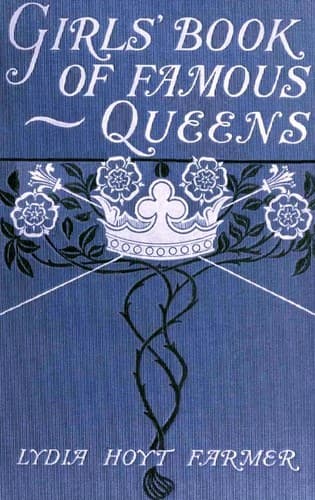
The Girls' Book of Famous QueensFarmer, Lydia Hoyt
History
The Girls' Book of Famous Queens
Farmer, Lydia Hoyt
Queens -- Biography -- Juvenile literature
For some time no one could be prevailed upon to do it, but finally
her favorite, Zuboff, approached Catherine and whispered to her. The
blood rushed to her face and, attempting to rise, she staggered. But
she controlled herself with a mighty effort, and dismissing her court
under the pretence that the king of Sweden was suddenly indisposed,
retired to her cabinet.
The poor Princess Alexandrina was conducted to her apartment, where she
fainted away. In her tender heart, a sad and crushing sorrow mingled
with mortification and wounded pride; but Catherine the imperial,
Catherine the imperious,—what were her sensations?
“Braved on her throne, insulted in her court, overreached in her
policy, she could only sustain herself by the hope of vengeance. Pride
and state etiquette forbade any expression of temper, but the effect
on her frame was perhaps more than fatal. The king of Sweden took his
departure a few days afterward, and Catherine, who from that instant
meditated his destruction, was preparing all the resources of her great
empire for war,—war on every side,—when the death stroke came, and she
fell, like a sorceress, suffocated among her own poisons.”
Upon the 9th of November, 1796, she was found by her attendants
stretched upon the floor of her apartment, struck by apoplexy. All
attempts to reanimate her were in vain; and on the following day,
without having had one moment granted her to think, to prepare, or to
repent, this terrible and depraved old woman was hurried out of the
world, with all her sins upon her head.
Such was the end of her whom the Prince de Ligne had pompously styled
“_Catherine la Grande_.”
Though her political crimes and private sins were such as to consign
her to universal execration, she seems to have possessed all the graces
of an accomplished Frenchwoman.
In her personal deportment, and in the circle of her court, she was
kind, easy, and good-humored. Her serenity of temper and composure of
manner were remarkable; and the contrast between the simplicity of her
deportment in private and the grandeur of her situation rendered her
exceedingly fascinating.
She possessed so many accomplishments, was so elegant and dignified,
and performed with such majesty and decorum all the external functions
of royalty, that none approached her without respect and admiration;
but her selfishness and her depravity spoiled all, and made her what we
have seen her.
Among all the famous queens of history, there is not one, save
Catherine de’ Medici, whose career is so utterly devoid of noble acts,
so entirely dictated by “selfishness, lust, and sordid greed,” as that
of Catherine II., removed by the grace of God on the 10th of November,
1796, from being longer empress of all the Russias, and from the world
which she had done so much to pollute.
MARIE ANTOINETTE.
A.D. 1755-1793.
“It is our royal state that yields
This bitterness of woe.”—WORDSWORTH.
Public-domain text, read in full here on John Shaqi.
Reviews
Reviews
No reviews yet
Be the first to share your thoughts on this work.
Elsewhere in the archive
Join the Discussion
Join the discussion
Sign in to leave a comment or review.
Sign InorCreate an account